26 May 2007

Entangled

The non-specific longing that engulfed me at age 15 remains the most sustained spasm of feeling I have ever experienced. I had always been prone to crushes and flights of fantasy, but as my freshman year of high school commenced, I became a heat-seeking boyfriend missile--only, my guidance system was completely off. The resultant frustration and loneliness were 24-hours-and-7-days challenging.
 
I expended a lot of energy imagining the scenarios that would result in BOYFRIEND. Every school-dance poster brought a surge of hope--although my stepfather held the keys to my fate there, as he would capriciously decide whether I could go or not. Usually, he said that I couldn't. Since these dances involved a nighttime subway trip from Queens to NYC and back, I could understand, even when his decision devastated me. And even when I did go, I pressed my back against the wall and observed blocky movements out on the floor, mentally beating myself for being a non-entity.
 
By sophomore year, I'd crafted a master plan of sleepovers at my friend Alexandra's house that released me into the latenight Manhattan world. With emerging bravery, I displayed my best dance moves with various crush victims (never slow-dancing, sadly). Almost always, there were exhilarating post-dance conversations with those same quarries at bars or ice-cream parlors or pizza places--the oases of colored light in the blackness of New York night. Nonetheless, and maddeningly, I was still unable to maneuver a boy into asking me out. Or even spontaneously kissing me. Much less kissing me.
 
One problem was, I had absolutely no idea what I would do to said elusive boyfriend if I got my trembling hands on him. I had long since received the stone tablets of the facts of life, handed down by my mother when I was in fourth grade. (Bless her for understanding that I was intellectually ready and thirsty to know.)  I consumed young-adult romances like they were self-help books. I certainly understood that there was kissing, and then there was kissing. I knew a boy's trembling hands would start wandering around my shirt front at some point, once kissing commenced. And I had read plenty about the post-foreplay penetration...an activity so mind-blowingly absurd that I dismissed it from any considerations. At any rate, these physical movements existed in a black box of actual sensation. So, essentially, I desperately craved a black box.
 
I did think I knew what it would feel like to have a constant companion--a love sidekick--who would share my interests, praise my music choices, laugh with me, read my writing, and sling an arm around my back when I wasn't expecting it, to remind me that I finally existed in a circle. I belonged. Perhaps this was a lot to load on the average teenage boy.
 
Perhaps it wasn't.
 
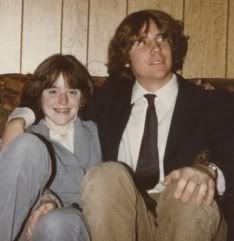
Reader, I met him. In the most mundane place: French class. He sat alongside me--assigned seats--and for months I had taken notice of his longish light-brown hair that curled despite any efforts to comb it, the relative heft of his shoulders inside the navy-blue blazer we all had to wear, the stylish corduroys (1979, remember) and the smiling eyes behind big aviators (again, 1979). One day I took notice of something far more revelatory: he had doodled Yes on his notebook. The band name. In its logotype.
 
This, I could launch a conversation out of. For which I must be eternally grateful to my brother, the music fanatic, who had long since infected me with encyclopedic knowledge and my-band's-better-than-yours attitude.
 
"Rob," I said casually, "you like Yes?"
 
He turned left and met my gaze. "Yeah!" he said eagerly. "Seen them a few times live, in fact. They're incredible. [Insert an excited discourse about their elaborate stage set, which I listened to indulgently.] Why, do you like them?"
 
I tilted my head in somewhat-assent. "Yeah," I said. "But Genesis is better."
 
His eyes popped. Really, they did. Score. Rob's response was a diatribe that included words like "sucks." Thus raising my hackles. And for weeks after, we traded barbs about Genesis versus Yes, making escalating claims of superiority based on music that we had rushed home to listen to the night before. A spiraling keyboard solo here, a particularly inspiring vocal there. Guitar prowess. Drum dominance. All delivered to each other across the bow of our French desks, with the slightest twinkle in our eyes.
 
As the dialogue continued, we both started making concessions about the other's favorite, because I was popping in my brother's Yes tapes for comparative purposes, and Rob had taken to analyzing Genesis as closely as Yes. So I became familiar with many of Yes' charms, Rob developed serious fondness for Genesis, and our arguments morphed into encouragements.
 
Most importantly, all this prog rock gave final shape to my burgeoning sense of romance. Cool water on the hot rocks of my wanting. These bands did everything BIG, with ebbs and swells of sound, and lyrics at once obscure and emotionally charged. I felt championed and supported by this music; long nights alone in my room were less desolate.
 
It would be untrue to say that the Genesis-Yes Wars (as Rob and I came to refer to them) were an instant guarantor of romance. No, it took an agonizing year for that to happen. Turns out that Rob was as constrained by inexperience and urgency as I was. But we forged a friendship that ranged beyond music, got to know each other's quirks (plenty on both sides), made each other laugh all the time...became companions. Finally, in the spring of 1980, Rob's friend Larry--an everlasting sparkplug, one of the funniest people I've ever known--became impatient with all of this mooning in the guise of friendship. He prodded Rob to take action, even gave him careful instructions--just as my friends began insisting that I had to do something (because they were dog-tired of hearing me moan about it). And they were right: I had taken to making journal entries in grey marker, for God's sake, to reflect the hopeless that wrapped around me. Besotted poetry excerpt from said journal:
 
a journey into the center of your eyes takes me
farther into myself than I'd ever believed was possible...
joins your dreams with mine
and makes them all come true
and makes your thoughts my words...
 
A pounding in my head: Rob, Rob, Rob. And yet every day I hung out with him cheerfully, never giving voice to anything I was feeling.
 
I always figured that a boy would ask me out under cover of darkness. Hence my frequent engineering of sleepovers, so I could make myself available for the big mo. Yet Rob chose full-on afternoon, in Central Park...a place we had been together many, many times, just two blocks from our school. In fact, the Park was the refuge for those of us who despised the sweaty drill of gym class. Improbably, instead of gym, we dissenters were allowed to go to the Park without a teacher and jog. (I know, it strains the imagination, doesn't it? So 20th century.) A ragtag band of about eight kids would bang out of the gym doors, blinking in sudden sunshine, and head two blocks west. Once the Park's majestic treetops became visible, a subgroup of stoners would veer off to the right, and the rest of us would go to the Reservoir and make some attempt to plod faster than usual around a wide oval. Rob and I used this time for deep conversations, which would start to get breathless until we gave up on trotting and returned to sensible walking.
 
That fateful day, spring had overswept the city, dressing its greys in ballgowns of blossoms. As we half-jogged, Rob and I engaged in a strange, stilted conversation about the idea of going out as we walked the Park paths. I don't think I overwhelmed him with enthusiasm, because a) I was constricted with nerves, and b) I had finally learned something about not scaring off my prey. After the words had been released, rendering us boyfriend and girlfriend in name only, we returned to school--gym was the last class of the day. Once we had changed clothes and the final bell rang by the lockers, Rob and I reconvened and headed for 86th Street, to grab the subway downtown.
 
For an hour now, ever since the conversation, I'd felt like a newborn--overwhelmed by the everyday. Now everything was different in the context of everything being the same. I wondered if I would feel this way forever, until Rob snapped me out of it. At the mouth of the station on 86th and Lex--where streams of people crisscross on the sidewalk, either heading down into the subway, or coming up from it--he stopped me by touching my arm, and then he delivered one electric kiss right there where we stood. My lips tingled with the jolt. As we took the grimy steps downward, I didn't feel the impact under my feet. Perhaps I really was floating.
 
Why am I reliving this? Well, last Thursday, Genesis was issued some kind of Rock Honors thing from VH1. Now, 27 years after I championed them between filmstrips in French class, they are being acknowledged as innovators, masters, leaders. No matter. They were all of those things for me back then, and as the VH1 broadcast brought the full range of their music to the masses, I sat back on the sofa, overspread with the heady, painful confusion and the final sweet payoff of 1980.
 
Tune in next time for: How Alcohol Led to Kissing.  

08 May 2007

The Diamond Anniversary

On May 8, 1932, a 35-year-old woman prepared for her wedding. A wedding she never expected to have, which resulted from a love story she never expected to be living. Her intended was 28 years old, a Canadian who had moved to her small Maine town eight years ago. You could say they were a study in contrasts: Fred was 5-foot-9, the very definition of strapping.

Whereas Theresa (always called Tut) was 5-foot-2 in her shoes. Even in her 30s, she was as adorable and diminutive as a doll.


Tut's temperament was doll-like, too…cheery, loving, and devoted. Fred--well, Fred was devoted to her, there was no question of that. But impatient! oh, never could anyone become exasperated like him. Not angry, not mean…just sputtery and annoyed. Tut smiled to herself whenever she thought of it. This man endeared himself to her with every fluster, every bluster. She calmed Fred, soothed him, and humored him. He had never smiled the way that she made him smile.

But married, she never expected. Fred started courting Tut when he was barely 21. How many times had she shaken her red-haired head and redirected him to a younger single woman in town? She thought Fred charming and insistent, but just a little misguided. Because Tut's devotion was to her parents. As their youngest, she had pledged that she would never leave home. Six siblings had left before her, married, and produced some two dozen children among them--all of whom cherished their Aunt Tutty for her uncomplicated generosity and young spirit. But really, Tut stayed behind for an unspoken reason that caused her pain, alarm, and concern in a mixed jumble: her parents' relationship was frayed, if not ruined completely.

Mama had always relied on her four daughters for house-tending and chores…even for cooking. With Mama now in her seventies, Tut was left to manage the household. What's worse, Mama held a seething grudge against her husband for the loss of their first home to foreclosure, two decades before. Tut adored her papa, who was temperamentally more like her than anyone else in the entire family. Papa was a peacemaker, an oasis of calm. Mama's fiery Irish ways may have drawn him irresistibly in their youth, but now she threatened to overwhelm him with spite. Tut served as their bridge, and for love of both of them, she would never leave.

Fred knew all of this. Years prior, he had heard it in conversation with Tut (as well as her friends, who privately mourned the spinster path she was on). Then, Fred gradually got to know her family. He saw the jagged dynamics in person. And he made a simple statement to the beautiful woman he wanted to marry: "I will never take you away. If you want to live with your parents, I'll do that."

Tut let herself fall in love with him at that moment. But she didn't let on, right away. Fred's desire, his adoration was almost too much for her to bear. Whenever she looked in the mirror, she saw a woman eight years his senior. What kind of existence would this be for a young man in his twenties, the prime of his life? Why, at her age, she probably wouldn't even be able to bear him one child, let alone the many that her sisters had borne.

On May 8, 1932, Theresa adjusted her hair nervously in that same mirror. She wore a modest dress, not fancy wedding attire. Fred was a Methodist, and Tut was devoutly Catholic. For this reason, the wedding was to be held in the rectory of the church: a non-event, meant to deflect attention. Her sister and brother-in-law would serve as witnesses. No guests, no rice, no toasts, no extravagance. Just two people--opposites, attracted--in a small town.

Make that three people. Inside her that day, Tut nurtured a new life--the hidden fact of a pregnancy. Her lifelong modesty makes it impossible to imagine the moment that she gave in to Fred's advances. In a boxy old car? Unthinkable. In her parents' house? Never. In the rooming house where Fred lived sparsely? Doubtful. The place is not important, anyway. Somehow, in the winter of 1932, Fred had convinced Tut. And at the age of 35, she must have asked herself, what was there to lose, really?

No one in Millinocket, Maine, would have been surprised at the subsequent wedding of Fred and Tut. There was nothing abrupt about it; they had been dating for four years solid. Surely their acquaintances rejoiced, having known for years what a perfect couple they made. And her nieces and nephews clung to Fred's lanky frame as though he were already their uncle. Therefore, the baby that Tut carried on May 8 remained a closely held secret. Instead, a few weeks after the priest pronounced them man and wife, Tut and Fred shared joyful news with family and friends that made sense in the timeline: now, they were expecting.

Tut's parents allotted the newlyweds the upstairs of their old, austere house. Tut, who had worked all of her adult life as a gregarious telephone operator, gave up her job and took an even more active role in her parents' daily lives. Fred worked long hours as a railroad telegrapher to support them.

Some months later, the trees were bare, the winds grew cold, and the birth of their baby was nearing--substantially sooner than anyone would have thought. In a masterstroke of plotting, Tut was sent south on the Bangor and Aroostook Railroad to visit her sister Nellie in Augusta. There, Tut awaited her confinement, which came "prematurely" (Fred told the folks back home). Her sister was undoubtedly in on the ruse. In Augusta, on November 27, 1932, Tut delivered a full-term baby girl.

Perhaps Tut would have been better off delivering a preemie. Her tiny pelvis struggled with the birthing, and in the days afterwards, she experienced intestinal difficulties that threatened her life. At one point, the doctor admonished Fred: "Don't ever get her pregnant again." He visibly blanched, nodding his assent.

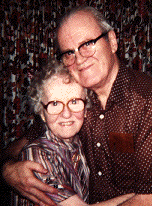
These events of 75 years ago are part of my DNA. The baby girl was my mother, Maryann. Tut and Fred were my beloved grandparents, from whom I learned about marital love, attraction, respect, and cooperation. It is nearly impossible to explain how safe and cherished I felt in their company--it was beyond a parenting relationship, into something spiritual, a glow that suffused me.

It wasn't until my young adulthood that I learned the full story surrounding this wedding day, and the secret they harbored throughout the years. As the puzzle pieces fell into place, I understood why they never, ever celebrated their anniversary, why they had no wedding pictures, no wedding memories. And as I contemplated all of these events on this year's anniversary--which I choose to commemorate, despite the fact that both Fred and Tut are both deceased--I couldn't help but wonder at the contrast between their surreptitious wedding day, and their lifelong, deep-rooted, inspiring love for each other. In my life, I've met maybe a dozen married couples whose bond and friendship is immediately, tangibly obvious. I compare all of them to my grandparents, who showed me that first.


How sad that the day these loving people were married brought them guilt and shame. How triumphant that they stayed together for life, and never let that submerged secret spoil what they had. My mother's birth, after the complications were cleared, fulfilled both of them in a way I don't think they had anticipated. And while I know they ached for more children, Fred would never have risked losing his sweet wife. Instead, when their two grandchildren arrived, they shared all of that long-held parenting energy with my brother and me. For that, I owe them everything.

Through all of the tumult and nerves, 75 years ago, I can see a moment in the rectory--maybe when the priest was droning from a text in front of him, maybe when the plain gold bands were exchanged--when Fred looked at Tut, caught her eye, and smiled that mischievous and satisfied smile that only she could elicit. And at that moment, I know she smiled right back. Her misgivings had been foolish. He was the one.

An important footnote to this story: up until tonight, I had never seen a photograph of my grandparents' wedding day. I decided to flip through my digital archives to illustrate this story--I have many images of them, just not of their wedding.

Two years ago, my cousin Earle e-mailed me some images, and those were among the files I looked at tonight. I'm very fond of one of them, which appears below. Ever since Earle sent it, I've puzzled over it: why are Nana and Grampy standing there so awkwardly, on the right? Who are the two people with them? Where are they, anyway?


In a bolt of clarity that any genealogist will understand, I suddenly realized tonight that this is the only surviving wedding picture. They are standing on a hillside: that's right across the street from Millinocket's Catholic church. I know that hill like the back of my hand. The two people on the left? That's the witnesses, Eugene and Essie.

First I felt driven to write about their wedding day, and then, I saw it. The ancestors speak to us, that's all I can tell you. And tonight, their diamond anniversary, they led me to this.

23 January 2007

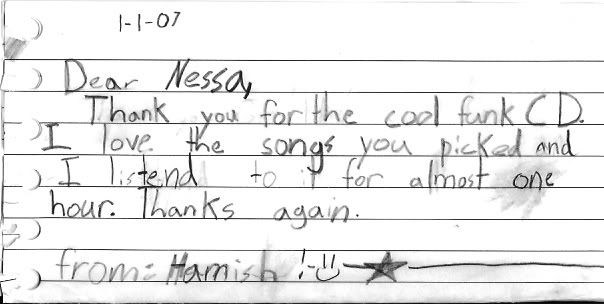
Dear Hamish,


Thanks for your note! When your mom told me how much you love funk music, I was just bowled over, and I couldn't get to the iTunes to make that mix disc fast enough. It's not every fourth-grader who appreciates that genre...and I should know, because when I was a fourth-grader, I did.

When I listen to the Spinners now, or James Brown, the Isleys, or Eddie Kendricks, it takes my mind back to graffiti-drenched New York City when I was your age. A place where considerable despair dwelled alongside joyful mellowship. The funk vibe was everywhere, bringing social commentary and free escape in equal doses. Just like the graffiti: a desperate expression...but the colors! Whenever a RR train rocketed past on the el tracks, a few blocks from my apartment building, I would stop and look up at the spectacle. Blocky letters, airbrushy splashes, in vivid-to-lurid tones, flying by. Really, it was like a comic-book blast up there, a save-the-day! message.

The day needed saving...a lot of crime and poverty, back then. It seemed like even the sanitation department had given up on trying to tidy the place, so when I played in the outdoor courtyard of the apartment building with my friends, there was this perpetual grime, a grey dust all over the stoop, the sidewalk, wherever we sat. It never fazed me, not once. (Only the mom in me is taken aback, thinking of it now.) Because when you looked up, up, past the roofline of our building, past the surprisingly tall trees in front...the sky was incredible blue.

Playtime outside in that era demanded a transistor radio. Everyone had one--they were boxy little rectangles with a blippy dial. In our neighborhood, you toggled between WABC, WNBC, and--if you were lucky enough to have FM--WPLJ and WNEW. These stations cooked up a stew that included funk along with rock and pop.

Soon, we would all start acquiring boom boxes. That term sounds silly and dated now, but in 1977 it meant a holy grail of sound. That's because a boom box was BIG--like, eight times the size of a transistor--and it was (you'd catch your breath on this word) stereo. Most of us had never heard stereo before--most certainly, never in the streets. Boom boxes liberated sound quality from its tether in the living room. In NYC, when you weren't at school or eating a meal, you wanted to be in the streets; and out there, musical accompaniment was crucial. Stereo wove the sound around your group of friends, made you want to stay out and hang together longer.

The first song I ever heard in stereo was, alas, not funk. It was "Dreams" by Fleetwood Mac. My older brother handed me his new headphones--the puffy bubble kind, from Radio Shack--and switched on his new boom box. "Listen to this," he said. The song was mixed to drift and pulse, left channel to right channel. I actually got shivers, hearing the wide-open terrain of that sound--Lindsay Buckingham's haunted guitar notes chiming, setting the stage for Stevie Nicks' plaintive vocal.

Hamish, your mom told me you like disco, too, and I'm proud of you for that. Like boom box, disco is a term that is unfairly maligned. It symbolizes faddish things, but the music must not be confused with the attire and dance moves it spawned. The best disco grows from a funk root, and when you hear it, if you're open-minded--as you obviously are!--you're compelled to move and groove.

So thank you, Hamish, for the memories you are making right now, which will equate funk and joy and expression with downeast Maine. You've underscored what I already knew: that genre of music is universal, and it stays with you like a companion for as long as you're true to yourself.

26 October 2006

"I challenge you to a game of Beer Pong"

The quoted sentence above was said to me exactly half my life ago. My senior year of college, which had just begun, was proving...tricky. I had just completed my final officership in my coed fraternity, AD--I'd been Fall Rush Chair. And the sentence above was said to me by one of the new pledges.

Fair to say that I had been flirting with this freshman since I'd met him at Rush. Although I'm by no means an overt or even terribly effective flirt. And I knew from my frathouse intel that this freshman was scoring quite well among the women of Bowdoin College (primarily the upper classes, which impressed us). His success didn't surprise me--he was, somehow, slightly more knowing than his classmates. Not full of himself at all, but a subtle, beguiling confidence in his manner. He was phenomenally tall--6 foot 5--and his lankiness just accentuated the skywardness. Still, despite the lack of bulk on him, you could tell he was a jock (of the tennis-squash ilk).

What made me flirt with this tall drink of water were the following things:

--he loved wry observations, both making them and hearing them

--when he laughed, the room brightened a little

--he was a kickass beer-pong player, right from the start...and I practically lived at that pong table

--whenever I couldn't finish a meal, he would gladly reach across and grab whatever was left on my plate

--his eyes were this undefinable shade of blue-green that I still haven't figured out

--I liked looking at him

Mind you, none of these things had really coalesced in my mind on October 25, 1985, when he uttered the title statement. I was frantically busy and emotionally off-balance at that moment--in a relationship that was sputtering, partying too much, taking honors-level courses that were truly tough, confronted with what the hell am I going to do when I graduate?, and desperately missing my former roommate and partner-in-crime, Geoff, who had left for junior year in Scotland. Yup, I was a box of broken toys right then, so any flirtations were happening despite myself.

Peter challenged me to beer pong on a nondescript Friday evening. The main party of that night had not kicked in yet; house members were scattered around doing other things. I looked him (upwards) in the eye and accepted his challenge. So we clattered down the basement stairs of our house, flipped on the light, and seized our paddles.

The stereo was locked up because the party hadn't started yet. That kind of thwarted me, because beer pong thrives on cranky rock music--I always felt awkward when pik-pok-plunknoises were all that you could hear. Kind of played up the absurdity of the enterprise at hand, plus it's hard to shout in triumph or despair when there's no loud wall of music to absorb the sound. [Quick insertion of pong rules: you put your beer cup right in front of you on the table, as does your opponent, and you play regular ping-pong, only you must try to hit the opposing cup. Hit on the side, one sip; hit the rim, three sips; if the ball sinks into the cup, chug. Repeat.]

That night I was feeling the ambient awkwardness. Pete and I were both going for it 100%, as I was widely considered a champion pong player, and he was impressively good and intensely competitive. A few pik-pok minutes passed, and I said with a surge of senior ennui, "I can't believe I'm playing beer pong with an 18-year-old."

(What did that mean?! I was 21!! Back then, it felt like a chasm.)

And across the table came a subtly confident Peter answer: "I'm 19."

In my mind, there was a sound effect like a Looney Tunes anvil hitting the ground. I looked across the table with totally new eyes and saw his smiling face...that brightening. Not only did his adjusted age make me feel better about my suddenly so-obvious-to-me crush, but the way he said it showed that he had something else in mind, too. A-ha.

We played pong till giddiness set in. I cannot remember how long that took; I cannot remember who won. Then we retreated to the TV room, which was at that time the incubator of all AD romances. Here was the drill: emergent couple sits stiffly alongside each other on a mushy old sofa, watching MTV with whomever else happens to be in there. You wait the others out...they trickle upstairs to bed, one by one...and then when they're gone: let the making-out begin.

Peter and I brought an innovation to this plan: we tossed a blanket over our legs and held hands underneath. I recall so vividly what that secret touch felt like: an inner thrill that has never left me, ever since.

We made out for awhile, but it was late by then (3 a.m.--damn you, Kester! :) ) and I craved being warm and horizontal in the dark. So I invited him upstairs. That smile again...we both stood up. Walking toward the stairs, we paused in the front hallway, which was bathed in light from the grand old center fixture...the rest of the downstairs was deserted and dark.

We faced each other and Peter pulled me into our first real embrace. My nose met him at chest-level, leaning into his soft-grey Bowdoin sweatshirt. And I breathed a scent, I kid you not, that was home. This man, this was the one. I knew it right at that moment, and I sighed.

As we separated to look at each other, I said, "Mmmmm...what is that smell?"

Peter pondered, then he said "...Bounce." Which made me smile, because it was so mundane and unassuming. And I knew it was so much more than that. I took his hand and we started up the stairs.

I love you, Peter. Happy anniversary. Be near me, be near....

20 October 2006

Meeting Ellen

There's a lot of paternalism about genealogy. The surnames that motivate most family historians are paternal--understandably so, since those names stay the same (well, nearly, given the vicissitudes of spelling and immigration). Male decisions seem to have motivated most of the migratory shifts that make my genealogy what it is-the choices that brought French, Irish, German, English, Welsh, etc. etc. all together to ultimately produce me and Peter. When you input "occupation" for an ancestor, you're adding in an array of arcane pursuits: carpenter, farmer, miner, cigar roller, paper maker, railroad station agent--but usually the women's are pretty basic: "keeping house" was the nineteenth-century census shorthand for being a mother and a wife. I always picture those beleaguered 1800s women clutching a broom as the census taker enters the house. Yup, there she is, keeping house...just like all the other women on this block. Then the census taker scribbles it in the occupation box with a knowing sigh. I then force myself to comprehend what those women's occupations meant: tending home and hearth for a dozen or more children, preparing meals over an actual fire, sewing clothing, darning, washing everything in sight, tending to injuries, worrying, probably pregnant again, dispensing love in a harsh world.

If you've read this blog for awhile, you already know that I'm a major grandmother fan. So when I started out mining data for family history purposes, my motivation was actually much more maternal than it was paternal. Both my grampy and my dad had lost their mothers suddenly and tragically, and they talked about them in vivid ways. Who were these women? Where did they come from?

It's been six years now since I set my mind, my heart, and my computer to the task of gathering my family--and Pete's--into a full-blown databased entity. Six years of meet-ups with excited cousins...weepy moments in musty record rooms when the piece of data confirms a family legend...long, lonely nights of data entry, the sounds of my household swirling behind me as I type and type and type...triumphant print-outs that show my progress.

And last night, I met my mother's mother's mother's mother. Ellen Finn, of County Cork, Ireland.

Well, I knew about her before. But a key piece of photographic evidence seems to indicate that now, I have seen her at three stages of her life:

The image on the right was just given to me by an elder cousin who stated that this was his grandmother, Ellen Finn. And the other two images had previously been given to me by cousins who shrugged and said, "I don't know who this is. Maybe you can figure it out."

Before I met Ellen photographically, I had assembled her life story from family lore and stark data. She was one of three (if not four) siblings in her family to emigrate from a famine-stricken location to, of all places, northern Maine. She made this journey by way of the Baie des Chaleurs, which curves around the northern portion of New Brunswick, Canada. Ellen arrived in Maine circa 1851, around age 17. Within the year she had married my great-great-grandfather, William Emmett Brown, also a recent Irish immigrant. They established a household that overlooked a shimmering lake encircled by pines and birches and maples...not a Vacationland lake, mind you, but a lake teeming with fish to feed a family. Then, Ellen's husband set about defining the town government structure of what became Eagle Lake, Maine. He was also a healer (both faith- and medicine-based), and took frequent journeys with a horse and a buggy full of remedies to southern Maine and Massachusetts, where presumably people paid him to feel better from rheumatism, pleurisy, dropsy, hysteria, and other ailments of the era.

Ellen, true to census form, kept house while William roamed. She bore him at least 10 children. I believe that she wielded a broom fiercely, and probably took a few swipes at that dreamer husband of hers when he got a wild idea about traveling south again. 

Eventually, William opened Eagle Lake's first pharmacy, which apparently brought some level of prosperity because Ellen got a servant. In fact, some of my living cousins are the children of the young maid named Delia who took care of the Brown household. Delia was about 14 when she started that job; she was 15 when one of Ellen and William's sons took her for his bride. (For a glimpse of turn-of-the-century mores, please note that he was 25. And that in their wedding picture, he looks dashing and daring, and she looks blue-eyed-pretty and a little stunned.) 

Delia always told her children that Ellen was fiery. That she had a thick Irish brogue, which even applied to French phrases like Baie des Chaleurs (which Ellen referred to as theBay dee Chaloor.) Probably Ellen's stiff demeanor came from a lifetime of sacrifices. She left County Cork and never saw her parents or her homeland again. She adapted to a place that was freezing cold for much of the year, where 98% of the people were native French speakers, and where her husband was out-and-about in pursuit of business, politics, and, bizarrely, the instinct to heal. She lost a number of children in her lifetime, including her youngest son, who was forced to flee west when a local girl accused him of getting her pregnant. The son, Edmund, swore it was not his child. Ellen and her children rallied behind him and shipped him off to Minnesota, where Ellen's brother Thomas resided. Ellen must have lamented his departure terribly...for just one year prior, her husband had died.

Here's something else I have learned about Ellen: she had a soft side. Maybe she didn't want us to know that--I mean, look at the way she glares out of those photos that bring her to us. But what betrayed her was her beautiful singing voice. Numerous grandchildren remembered being held in Ellen's arms in a rocking chair, while she sang to them in Gaelic. Some reported that Ellen had aspired to be a professional singer, before the boat came and hauled her away to northern Maine for the rest of her days. I feel certain that her lilting voice is what endeared her to William Emmett Brown, the dreamer who needed a practical partner.

Perhaps the baby in her arms, above, was one of the grandchildren whose night fears she soothed with a clear and lovely voice. Keeping house, indeed, for all of us who descend from her.

12 October 2006

Tiger's Eye

Technically, it was our first date, but we never called it that. You took me to the movies...Rocky, what, III? "Eye of the Tiger"...that one. A Sunday evening. You and I sat as close as we could with a seat arm between us, our right and left arms twined together, and each hand exploring the other. It was the gentlest touching I'd ever felt, our fingers just slowly moving around--independent and in sync, simultaneously. There's not a good verb for it: stroking...caressing...feeling... no. It was learning.

A lot of my teenage movie dates had been obliterated by frantic making-out. Hard to see the screen around the blocky shape of an incoming boy's head, tilted for the impact. Rocky III was not that. Somehow we connected the pursuit and the intensity on the screen with our emerging romance--and so, we watched the flashing colors...so much red, white, and blue...and that blackness of boxing...the drama and the blur. Similarly, there was an aura of desperation between us, which was always expressed with grace and softness. We were urgent, since we barely had two months before I left home for college--but because of that, we treasured every mundane element of being together. Held it like glass, and looked at it from every angle. Savoring.

We used to say we were stopping time (both of us wrote poems about that, in fact). Walking with you on a misty summer night down an orange-lit city street, our arms locked around each other's backs, the scene felt suspended. Otherworldly. Yielding to our forward motion, but staying the same, as though we could crystallize our surroundings—as long as we were touching.
  
No afternoon ever lasted as long as being at Rockaway Beach with you. Scientifically, I now know that's because of the heat: hot temperatures have been proven to elongate one's perception of time. Well, that fact was a constant blessing to a summer relationship that was doomed by time. We'd lie there on the grainy sand, half-protected by a weak old beach towel, and the eternal blue of the Atlantic would shuuuush a few yards away, restless and endless, slopping water onto the sand in a gleam and then pulling it back. Next to our heads was some 1980s boomboxy rectangle with silver cones that pumped hard rock music, swirling all over us. We had a soundtrack. Keening voices, edged guitars, pounding drums, and tonight tonight lyrics. The sun seemed to take much longer to set at Rockaway, lingering on the weathered boardwalk slats. "we should leave now..." "I know...well, after this song..."

Nights in a rock club, standing near the stage, beer-buzzed, heads tilted up towards the colored spotlights and nodding in time. My midlife penchant for concertgoing directly grows from those times. If you could soak music into your pores...that's what we were after. Sweaty hair was a sign of success. And when we got tired, we'd go sit at one of those tippy little round tables, lean over with elbows against the damp tabletop, and kiss in the semi-dark until breathing became a challenge.

I learned that I was lovable. I learned that I could give my written words to someone else and he would own them and adore them. I learned that I could hurt someone when my every intention was to spare him. I learned that I was tired of being a virgin...and that sometimes, that wasn't enough to change a guy's mind. You were so careful, and I was all wanting. To think now that you saved me from my instincts while you were still just 16 years old...how fortunate I was. Although my inner 18-year-old still wonders why, and craves.

The adult knows: You understood that if we sealed the deal, I would stay. And despite the evident pain in your voice and on your face, you would have done anything to make me leave—thus forcing my future to open up wide. You told me many times that I had to go, and against my heart's leaning, I did what you instructed.

I was 18, you were 16. Who was the sage? Who was the acolyte? Promise me that we both gained.

You remain my sole case of love at first sight. (Trust me, it is possible. A thud in the heart and a sharp prod in the mind. And it laser-etches memories, thereafter. Case in point: ) You were standing at the other end of a long dining-room table. The table was dark wood, with a lace tablecloth. My eyes had traveled the length of the table, ending up at your thigh level. (You could say that I was sold right there: you in those teenage jeans that fit exactly right. Oh, the male shape.) I startled inwardly because I realized I was staring at your hips. So I glanced up to your neck--which was really 2/3s of the way to the bargain, because you had on a grandfather-collared shirt and a white shell necklace against your darker skin. Believe me, if I could have dressed my ideal boyfriend back then, I would have reached for everything you were wearing that night.)

Your face: oh. Done. A flash of brown eyes, mouth set in contemplation, all framed with careless black curls that grazed your neck. Your chin angled toward me, because you were looking at me with equal consideration.

I have no idea what I looked like that night. What was I wearing? Did I smile at you, despite my nerves and (the only word I can think of) worship? My hair was long and I probably tossed it back to recover my composure. And my eyes, I know they must have been sending a pleading message whether I wanted them to or not. Damn, I needed to be loved at that moment in my life.

The next voice I heard was the party hostess: "This is my sister's boyfriend..." Of course, I thought ruefully. (Never fear, young Nessa. In a week, he will have ended it with her, a surprise as big as the last unopened box at a birthday party. And so the summer will truly begin.)

What I owe you is inestimable. I wish we could talk about these experiences, expose them to scrutiny, revel that they happened. Ninety percent magic, ten percent reality. I suppose the reality is why we have never discussed those two months, in the dozen or so times we've seen each other since. No matter. What's important is never forgetting. Magic is too rare for that. And in the meantime, I'm just so glad that I have seen you, that I still know you, that your future opened up as wide as mine did.
----------------------------------------------------
The shuffled iTunes song that prompted this blog:
  
If you didn't care what happened to me,
And I didn't care for you,
We would zigzag our way through the boredom and pain,
Occasionally glancing up through the rain,
Wondering which of the buggers to blame
And watching for pigs on the wing.
  
—Pink Floyd, "Pigs on the Wing, Part 1"

09 October 2006

Nonagenarians

I'm done with the word "old". To the best of my ability, I'm going to try to avoid it. It's a judgement, it's a distancing and a defense mechanism, it's unfair.

Case in point: two people I am proud to call my friends: Dorothy and Linwood. They have never met, but they have this in common: they are nonagenarians. Linwood's 92, and Dot is 95. They live in opposite corners of the same state.

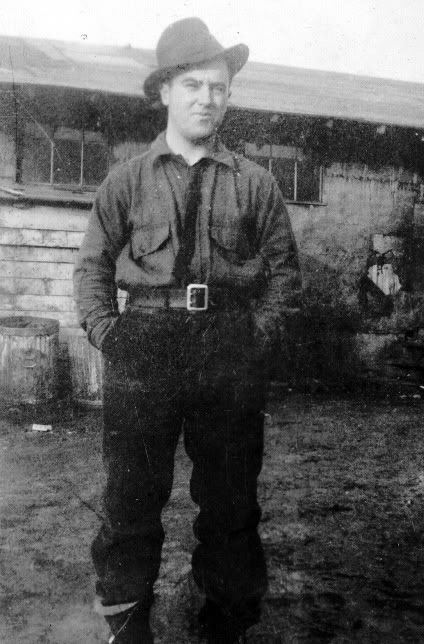
Linwood is a retired station agent for the Bangor and Aroostook Railroad. Before he began his railroad career, he worked for the Civilian Conservation Corps (yes, the CCC!) during the Depression, and he also served in the U.S. Army during World War II. The words I would use to describe Linwood are humility, grace, vast practical knowledge, and deep kindness. He's my 2nd cousin once removed: his grandmother's brother was my great-grandfather. In my mind's eye, he's in his kitchen, which is really his mother's kitchen. Very little has changed in that house since his birth...just that it's a little disheveled now in a bachelor way. He welcomes you in, anyhow, and carefully shares stories of his life and his town. Never sappy or long-winded...just brings his community to life with simple descriptions. I do the genealogy, and he tells me of the personalities behind the names, the relationships, the houses they owned, the losses they experienced. He doesn't tire of company, and I've never been bored in his presence, either.

When I saw him last month, I said, "You should come visit us down on the Island, Linwood!" (This is where his CCC work was conducted, and I know he has vivid memories of those times.) "No," he said easily. "I don't leave here now. My traveling is done." The serenity in his voice when he said that to me was inspiring. And it made me hug him a little harder, when we said goodbye. I only wish I lived closer.

Dot lived next door to us before we moved onto the Island in 1996. She had been in her home since the 1950s, never had children, and her husband died many years ago. Much as with Linwood, Dot's home remained as it had been when two people lived there. Her living room was anchored by a sturdy grand piano that her husband had played in his lifetime. "Oh, he played beautifully," Dot would say, and you knew by the look on her face that she could hear it as she said it--and that she still admired Robert, her life-partner and friend. The piano was like having him in the room, sitting alongside us companionably.

Her living room had a well-worn teddy bear which was fair game for all young guests to hold and play with, and a dark-wood cabinet full of vintage, much-read children's books. We've spent many afternoons filling her downstairs, the six of us, and she's always welcomed our noisy presence. We could still have a deep conversation around the clamor of children, and she never flinches when they take a corner too fast and veer near some knickknacks. Plus, she always demonstrates her heirloom cuckoo clock, cast-iron piggy bank with the trick cannon, windup dancing Scotsman in a bottle...what kid isn't fascinated by those things?

I have talked to Dot about absolutely everything: my mom's illness, my children's issues at school, tough moments at my job, religious beliefs, happenings in our community, you name it. The insights she has provided me, the alternate outlooks, have been a blessing in hard times. And when things go right, when something's achieved...she magnifies that joy. Sometimes she tells about her girlhood in Pennsylvania, where she was one of many daughters and just one brother. Often we talk about the influence of parents on children...her own remembered example as vivid as the ones rambling around in her downstairs rooms.

Dot's descriptors: welcoming, wise, compassionate, spiritual. Well-read without being stuffy. Disdains medicines whenever she can, preferring to rely on her own five senses without blunting them, to know whether she's healthy or not. Dot has soft, silky white hair that she wears long, usually braided. Her face crinkles in a smile, more often than not. And knowing, kindly blue eyes. She shares that with Linwood, too.

Last Thursday night, I picked up our weekly local paper. I usually don't read it, but something made me dive in. I felt like I should catch up, maybe. And where I least expected it, I got news that made me utter, "Oh no, oh no...." That was in the real-estate section. New Listing: an address, a house photo, a description. God, I know that house. My heart knows it. Still, I checked the address to be sure. It's Dot's.

Tonight, at dusk, we were up in Dot's town...our former town. We drove down her street and pulled into her driveway. Noted the accursed For Sale sign on the lawn. I was nursing a hope that Dot had made this choice herself; that she was still residing there while potential buyers deliberated. Charming them in conversation, during the inevitable open house. That hope was dashed as I approached her back door. Through the kitchen window, I could see clear to the other side. Wan sunset light streamed into an empty kitchen. I could see the floor. Everything was gone.

I turned and faced her backyard, tears welling. There was her garden, Dot's pride and joy. She and a handyman maintained this paradise every year. Forget-me-nots, roses, asters, cosmos, and many other flowers whose names I could not recall, though Dot knew them all. My kids walked these little pathways many times. So have Dot and I. Sometimes she would take my arm lightly as we walked, and I was glad to protect her for just that little time. It was the least I could do in return for all the acceptance and love she had given me.

Dot has family elsewhere and she may well be with them...I don't know yet. But what I do know is that the garden was wearing autumn colors of brown and grey, and muted green. Plants were bent and shriveled, flowers spindly and seedy, trees nearly bare. A birdhouse sat forlornly in the middle...Dot loved her bird visitors. As I walked away, the garden felt as empty as the house. The spirit was gone from it.

I got back to the van, slid into my seat, shared the terrible news. Then Zoe exclaimed from the back seat, pointing at the windshield: "Look! One of her favorites--up there!"

On the slope of Dot's roof was perched a bluejay, almost a silhouette against the sky save for the white markings on its back. I held my breath while I looked at it, this astonishing sign. Before I was ready, it twitched its tail merrily, half-turned, and flew away.

UPDATE, October 10, 2006

Thank you so much to everyone who commented on last night's blog. I was comforted and heartened by your words.

In true smalltown style, I found out about Dot's situation this afternoon. You see, when we lived next door to Dot in the '90s, we were renting. Our landlord from those days is now my daughter's chemistry teacher at the high school. So today, Zoe asked him what happened. It's the best possible scenario: Dot's in an assisted living center, right here in our region. Evidently the family decided she was too unsteady on her feet to stay alone in her home anymore. While I'm sure this turn of events has made my friend sad, I am relieved that someone is helping her out and keeping her safe. And I hope to visit her soon and hear what she thinks about this new chapter in her life.

I thought I would share a few photos to accompany the blog, since you responded with such warmth and enthusiasm. Here is a photo of Dot and me from 2003. We're standing in her homey kitchen, and she's holding one of the many exquisite plants she nurtured there:

As Linwood is my cousin, I have gathered many wonderful images of him as part of my genealogy work. (Last summer I brought a scanner to his kitchen, balanced it on the old stove with my trusty iMac alongside, and we scanned our way through his life story!) Here is Linwood as a young boy in his hometown of Eagle Lake:

I so want to know him in his young-boy days! He looks by turns impish and unusually thoughtful.

This is Linwood during his tenure in the Civilian Conservation Corps, circa 1934:


A dashing serviceman during World War II:

And last year, when I did all the scanning, I also took this photo of him. (He built all of the cabinetry you see behind him, when he came home from the war.)

Interestingly, a good friend of mine just returned from a celebration in Massachusetts: her great-aunt Rose's 100th birthday party. I wish I could show you a picture of Rose, who looked beautiful, poised, and completely unsurprised to be 100 years old. There are so many fascinating stories out there waiting to be told by the elders we love....

UPDATE II, October 22, 2006: Our Visit with Dot

Yesterday our whole family piled into a tiny room at an eldercare facility and enjoyed an hour with our dear friend Dot. It truly was the smallest room I've ever seen in such a facility...and that's saying a lot, because I've visited far too many loved ones in long-term care facilities over the years. It required an instantaneous readjustment: from Dot who lives in the stately lifetime home with the grand piano, to Dot in an embryonic space with dozens of photos around her, three plants, four stuffed animals, and a TV. And the requisite hospital bed, which Dot is evidently confined to, now. I didn't have the heart to ask her, but she seems to be bed-and wheelchair-bound.

My next jolt was her hair, which has been shorn to a bob and has lost its characteristic white softness. Another fact which I filed away silently.

In no way did these conditions reflect on her sunny, welcoming face. It was as though the woes of her body were floating away from her sweet personality--disconnected. Three of us sat on her bed, three jammed into a side chair. The younger kids fooled around with her teddy bear and stuffed kitty, and the rest of us shared news of our worlds. Dot marveled that we have two high schoolers now, and that the kids have such diverse interests. Zoe brought out her ever-present sketchbook and showed recent work—emotionally immediate images of young people with big anime eyes. Dot loved it. We drew Dot's attention to some of her photos, and she told us stories of various relatives and friends. Meanwhile, Zoe feverishly began sketching the oldest photo in the room: Dot's two older sisters and her only brother as preschoolers, attired in turn-of-the-century white garments with dark stockings and laced-up ankle boots.

Dot was fully cognizant of everything except the passage of time--she is not at all certain of how long she has been at the facility, nor did she recollect our last visit to her home in July 2006. With her world limited to this space and a couple of common rooms, I imagine the pattern of day-to-night-to-day feels entirely optional. This does not seem to bother her, which increases my admiration for her even more. Really, she seems to feel safe and enveloped in this place...like the next stop on a journey, nothing more, nothing less. So many homes like this have crocheted afghans all around them...that would be the symbolic representation of how she's feeling: warmly protected.

At one point, Lydia's newfound interest in playing piano came up. "Lydie," I said, "do you remember the big piano Dot had in her living room?" I could have clapped my hand over my mouth as soon as I'd finished--what the hell did I say that for?!--but I stayed rigid, waiting.

"Oh," Dot said immediately, "I sold the grand piano, you know."

"...oh?" I answered in a stammer.

"Yes, it's west of the Mississippi now," she said airily, as if to say, imagine that!, and we all laughed.

Dignity without stuffiness. Belief without dogma. Femininity without a second's fuss. Graciousness personified. As we prepared to leave, she said, "You can come back as often as you'd like. Please do!"

And I need to correct my previous entry: this incredible, serene woman is nearly 98 years old.