18 July 2006

Troubadours are my weakness


In 1995, Pete and I were experiencing a musical growth spurt, after a few years of parenting toddlers and feeling queasily out-of-it. We joined Columbia House (don't judge, they had an amazing alternative catalog back then) and soaked up new music videos wherever we could find them. One of our fave outlets for alterna-vids was a Boston-based show called Rage TV (http://www.ragetv.com/). In November 1995, Rage TVbrought me Francis Dunnery.

With a chunky Scots-Irish accent and a wry smile, he sat with his dog and talked with the show's host about his new record, Tall Blonde Helicopter. He got my attention because:

—I could somehow tell he was my age—which was just starting to seem novel, me being in my 30s and all.
—He was simultaneously beguiling yet laser-beam direct with his comments.
—Did I mention the accent?

After the interview segment, they ran the video for "Too Much Saturn," a slice-of-life story song lamenting (and lampooning) Dunnery's need to appear enlightened. It was like hearing a new style of poetry, that song. I stared openly at the television set and felt electrified by his sound and words. The next chance I got (this being pre-Amazon), I hunted down that LP. You know the feeling: one spin and you know this album will be burned in your consciousness forever? Yes, that. There were also multiple bisections between his experiences and mine. He sang about sobriety—a road I knew well and pursued determinedly. He sang about estrangement from his father. Check. He sang about lust and love in a way that mirrored where I was with Peter (still does). And he sang about sweet moments of parenthood. Sold!

You see him up there, that pic I led off with? He's standing in Central Park, 1995. I probably stood on that patch of grass as a teenager. New York was Francis' adopted home and he sang about that in terms that evoked my deep-dwelling home memories. 

The guiding principle of Francis Dunnery's music is unrepentant honesty and revelation. I need performers like him in my life, to calibrate myself.

Eleven years and three LPs later (all of which are DNA albums, to borrow a term from my daughter), Francis embarked on an international House Concerts tour. Last week, this tour actually brought him to Maine. And Peter and I got a babysitter (!) and stayed away from home overnight (!!) so that we could go see this man whom we've admired for so long. The first time in 17 years that we had been away from home & hearth for a full day and night, just the two of us. That alone was fortifying.

We had never met the host of this house concert, but he and his wife welcomed us warmly. We hesitantly stepped out onto their deck , a beautiful spot surrounded by the woodsy green of full-on Maine summer. Guests were milling around waiting for Dunnery to arrive, chatting and snacking. This is a social set-up that, nowadays, renders me mute and useless. I have lost all aplomb (see above: sobriety); I basically feel meek and unequal to people I meet at parties.

Ahhhh, but this was not a mere party. This was a gathering of like-minded individuals with a shared purpose. I sat next to a woman my age, and she initiated a conversation with me--amazing!--which instantly yielded numerous things to talk about. Pretty much everyone at the concert felt like a soul acquaintance whenever a conversation started: artists, musicians, writers, astrology believers, thinkers. So here was an extra bonus to the Peter-and-Nessa-just-the-two-of-us night.

And then, Francis arrived. We all went inside...the host's living room was built a few years ago, specifically to allow musical gatherings like this. The cathedral ceiling makes for exceptional acoustics. Pete and I snagged seats in the second row. Francis stepped to the front of the room and I nearly gasped. First of all was that moment of it's really him, the guy I listen to so much! But the kicker was when he hoisted his acoustic guitar. I knew he was a tall man--well over six feet, like my beloved hub. But I had never noticed how massive and thick his hands were. I watched in awe as he started playing delicate notes with those fingers, skating along the strings.

For a couple of hours, then, he performed, with rich banter in between. Much of the talking has to do with issues of midlife...once again, a perfect bisection for me. He also riffed about growing up Catholic, to hilarious effect--been there too. But the music...oh my. His voice soars on the high notes, undiminished by that midlife he talks about. His large hands form gorgeous chords, and geez can they move fast when he wills them to. Just a gift, to watch Francis play in close proximity.

I am the daughter and sister of musicians. Obviously, from my writings here, music is my life (I used to write that in my teenage diary all the time). But the muse Euterpe passed me over; I can't play an instrument. I love to sing, but I never believe in my ability to do it. Well, something came over me sitting in front of Francis Dunnery--me and other women in the audience. We started singing along, and adding harmony. Reminiscent of my Catholic-school choir days, really.

On one song, "I'm in Love," there's a female backup vocal that comes in on its own (sung by Dorie Jackson on the record...she's an apt complement to Dunnery). I knew when this vocal part was coming: "Stone cold in love," is the line. As the song built towards it, and I was grooving along, Francis looked me right in the eye and held on. With a challenging glint, as if he knew that I knew what the line was. Looking in his eyes made me brave. I sang it out loud. Alone, because no one else knew it was coming. And then he said, in that homeslice accent, "Exactly." And went on with the song, never breaking stride.

His tour manager told me after the concert that Francis had said backstage, "That was the moment of the show, right there."

Well, it was for me. Impressive what we can learn about ourselves in middle age, hmm? Some of the other guests came up to me after and said that I had a great voice. We need to hear that to really believe it, don't we? I felt like a watered flower.

Reader, I met him. But ever-so-briefly, because I was so absorbed in conversation with the others in attendance. Francis was on his way out when I got this picture taken with him:


File under bliss. I believe. What a peak experience.

06 June 2006

Keep your eyes on the road...

An augmented entry from my journal, July 27, 1982
(original journal text in Helvetica font)

Preface note: in 1982, the legal drinking age was 18. (This is not to say that my partying career began in 1982, but it does place this piece in some context.)

I worked as per ever Friday (oh, didn't mean to leave out Thursday 'cause I worked then too), 3 pm - 9 pm.

Summer of 1982. Freshman year of college beckoned, in piney, frozen New England. In the run-up, I was cashiering in a Queens, NY supermarket that made the United Nations look plain-vanilla. And forget about diplomacy—these shoppers were pissed off, almost as a rule. I'd grown up in this neighborhood, yet my Manhattan schooling had completely insulated me from its emotional volatility. I frequently got into multilingual arguments that had no chance of resolution, as neither party understood the epithets being hurled. One lady repeatedly jabbed me in the breastbone with a bony finger when I wouldn't allow her to buy nine jars of mayonnaise. She just didn't grasp the "limit three" comment in that week's circular. I was out of my depth, daily.

Rushed home in my usual state of exhaustion and then hurriedly got ready—for what, I didn't know: Sue and Chris had both neglected to call me. But I did know to expect them at 9:30.

Sue and Chris formed the core of my social life that summer: high school friend and new boyfriend, respectively. On that Friday, my working mom had not seen me all day, and I arrived home in a state of post-job agita like a snarling dad ready to blow off steam. So Mom got a half-hour of my unpleasant company while I shoveled in some Lean Cuisine entree that had been extruded from a snipped baggie onto my plate.

Chris came and we blubbered something about Pub 74 [a local hangout] to Mom, though I knew we REALLY had talked about seeing Sue's bungalow in Rockaway. Mom said to be home at 3, which we promised. HAH!

My stepfather had left for good that spring, and his absurdly strict rules had evaporated along with his wardrobe--jingling hangers dangled in his closet. For example, one night that wild summer, I failed to come home at all after promising to be home by 2. When I tiptoed into the apartment at 7:00 am, Mom sat up in bed (where she could see right into the front hallway) and intoned, "You're grounded." I laughed immediately, the selfsame "HAH!" that I'd inscribed in my journal, above.

Sue as much as asked where my pajamas were and I quickly realized "the crew" intended to sleep at the bungalow.

(You'd think I might've gotten laid out of this, but no dice. The Catholic kids I knew were way too freaked out by potential pregnancy to even attempt it.) The car I climbed into was a dull blue Opel. Its horn meeped like the Road Runner, and its owner, Eddie, was perpetually nursing a bottle of Bud as he drove. His (small-b) bud Barry rode shotgun, as always. Sue was in back with us. So we were transporting five teenagers in a car that might hold four, if two were skinny. The floor was totally obliterated by a tableau of empty brown bottles that rolled and clinked in tandem whenever the Opel came to a stop. My legs were draped over Chris' the whole way, a slight space saver. 

The supply of Budweisers in that car was boundless. Eddie never ran out, and the beers were always sweaty and just cold enough.

At 10:20 or so Eddie's wonderful car stalled dead on the Cross Bay Parkway in the middle of nowhere—nothing was within reasonable walking distance.

We milled around the Opel on a sultry New York night, each of us working a beer as we tried to figure out what next. It was hard to believe that Queens could contain such a deserted stretch within its borders--but then, I was learning a lot about my home borough this summer. You could hear crickets this far out. Jets crisscrossed overhead, into and out of Kennedy Airport. A few cars zoomed past us. Given that our only flares were hoisted glass bottles, who blames them for not stopping.

After an hour or so of frustrating waiting, a police car pushed us into Broad Channel.

I was too buzzed to observe how the police linked their car up to the Opel. They curtly told us all to get into the car, and once seated, they began nudging the vehicle forward. Eddie had been instructed to put it in neutral, and he clowned with the wheel at the 5 mph speed. Giggles and snickers overtook us, and then we heard the voice of God: "This is not a laughing matter." Wait, God had a bullhorn? No, that was the cop behind us, issuing the only warning we got for this escapade. Try not laughing with a beer buzz when someone orders you not to laugh, over a crackling bullhorn.

The cops abandoned us to our fate in front of a neighborhood bar.

Seriously. They shoved the car along just till we reached a semblance of civilization, and then they roared away. It really was a century ago, wasn't it? or is it just that there were far bigger crimes than ours to detect and prevent, so the police had no patience for the likes of us?

I was drowsing out in the back seat on Chris' lap—we were all drinking beers throughout this crisis, by the by--and Chris and Barry were joking around while Sue and Eddie tried to find us some means of getting—somewhere. We eventually met a guy named Joey in the bar, and he jump-started the car.

Quite wisely, in fact, the cops had left us in front of a bar that was in full drunken swing. Our own inebriation seemed tame against this wood-paneled, smoke-filled, pool-playing landscape. We crept through the crowd, parting sideways through people this way and that, and finally found a savior, the afore-mentioned Joey. Eddie probably slipped him a ten or something, and he assisted us gladly.

What happened next did not make it into my journal, surprisingly. Once the Opel was functional again, it remained for us to cross a long bridge into Rockaway. Fresh beers in hand, we tootled along with music blasting, vigor renewed--and as the road arched up onto the bridge, Eddie suddenly waggled his hands in the air. "Woooooooooo!" he yowled, the universal teenage sound effect for "I'm doing something really stupid that has a 50-50 chance of ending badly." My friends picked up the mood and someone sang out hoarsely, "Keep your eyes on the road, your hands upon the wheel!!" Eddie waved his arms higher, loving the Doors comparison. I remember rolling my eyes in the backseat, invisible in the darkness. Great, I thought ruefully, and then holy SHIT the road is about to CURVE—

Eddie noticed the bend ahead just in time, scrambled his hands back into place, and we swerved in the correct direction, almost magically. Chris muttered something darkly, and I rested my head on his shoulder because I knew he knew.

At about 12:45 or so we limped into Rockaway. Teresa [Sue's younger sister], who was waiting for us at the bungalow, was furious that we hadn't found a way to let her know our plight. We realized she wasn't in our crazed mood; the five of us grabbed Buds and went to a payphone to call our respective parents.

The preceding paragraph serves as a vivid reminder of what life was like before cell phones. If I remember correctly, the bungalow didn't have a working phone either, which makes Teresa's furor even more comical. How we were supposed to inform her? Carrier pigeon?

Mom, awakened from an undoubtedly sound sleep, was bitchy, bothered and bewildered when I called. I tried to impress upon her that this was a real story, not just a plan to ensure my staying in Rockaway, and at 1:00 am I really had no way to get home! She waxed snide and I hung up furious, and determined to have a good time with the rest of the crazy night.

Poor Mom. What else can I say? After four high school years of mostly toeing the line, I was finally rebelling openly. I was 18 years old; I was gainfully employed; I was tasting freedom (which tasted remarkably like Budweiser, most of the time). Mom was rendered powerless for the first time, and undoubtedly she felt disgusted with me. However, one bizarre factoid: she adored Chris. So even though he was my constant partner-in-crime all that summer, she forgave me every time because he'd been along. I suspect she believed that I dragged him haplessly into these disasters.

We went on the beach, then, from about 2 till 4. I spent most of that time with Chris, in the dark beauty of the beach at night. I won't even try to describe the intensity, the blackness of the water, or the sleepy, starry sky, or the yielding, damp sand...or the "tacky" lifeguard's chair. It was the ultimate romantic experience and I really didn't ever want it to end.

Yeah, no sex, but I'll tell you what: it was just as ecstatic. Especially from the top of the lifeguard's chair, the night hemming us in like a safe vacuum; wind and waves the only sound we could hear other than our voices. On this night, the reality of my departure for college was completely absent. We were breathing entirely different air, you could say. Focused on the here and now, with no concept of later. I mean, leaving for college...that was a month away. I wish I could bend time like that nowadays. Perhaps the beer helped.

We went back to the bungalow and tried to set up sleeping arrangements in a miniature room with three beds and a chair to work with. I was wet from the beach and afraid I'd never wake up if I slept, so I went to sit on the porch awhile.

Adult self to Nessa 1982: WHAT THE HELL WERE YOU THINKING?? You spend two hours locked to this guy, blissfully, and when you finally get him back to a place with a warm bed, you decide to stay awake alone, instead?! Sheesh, no wonder you went to college a virgin.

I got locked out,

Further evidence of my teenage genius...

and rather than wake everyone up, I shivered and watched the really slow dawn breaking (though a poetic experience, it was boring as hell). I was all cramped into a rocking chair.

So maybe I needed this separate time. Maybe I hadn't blocked out reality as thoroughly as I thought. I certainly remember those moments with astonishing clarity, all this time later. A star glimmered—from Queens, that's as much as you usually get, one star. I watched it, pondered it, wondered when it would fade. I noted the sky's transit from ink-black to curiously greyer-black, then the onset of morning blue. There was a faint blush of pink around the rim, nothing majestic. The star persisted longer than I thought it would.

At 6:15 I dropped off--blacked out is more like it, awaking with a start at 6:50.

The mother in me now forces me to say: Yes, I fell asleep on a street in Queens. Well, I was on the porch...I guess that was a little sheltered. But I was outdoors, yes.

I finally woke everyone up, grabbed a bed and warmed up for a half-hour under three blankets,

Alone...

had grape jelly and bread with butter sandwiches with Kool-Aid for breakfast,

[shudder] The bungalow was obviously not stocked for a teenage onslaught.

and then Sue, Teresa, Chris and I took a freezing air-conditioned bus back home, whilst Eddie and Barry administered first aid to the "fucking car".

From that night on, the Opel was always addressed as "fucking car". Like it was an unruly pet. I was relieved not to have to get back into that vehicle, but the bus was really, really cold. Combined with the shakiness I was feeling from lack of sleep, the ride home was unpleasant to the extreme. I might have had a light jacket, if that. I leaned against Chris, and each heave and bump of the road jolted me.

And now, friends, here is the punchline:

Somehow I worked 11:30 am-6 pm Saturday.

Ah, youth!! No hangovers, no repercussions, and no bounds. In a wonderfully circular way, this blog entry has brought me to the brink of dawn, and I'm shaking my exhausted head at the thought of my raring-to-go self. And basking in the vividness of memories that I burned into my consciousness, knowing full well I would want to summon them again, later.

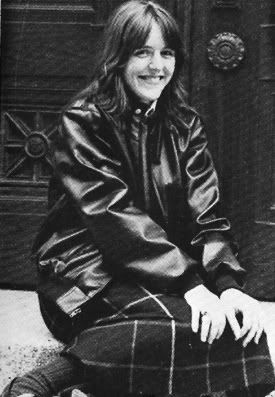
Nessa, circa 1982, courtesy of my yearbook:

01 May 2006

Living color

There is a color that I love, not in the let's-paint-a-wall way, but in the I-can't-wait-to-see-it-again way. It is the emergent green of everyday deciduous trees. Spring green. Tiny blossom-before-leaf green. It dangles beguilingly from a new leaf stem, curved almost flirtatiously toward the ground. Soon that little floret will drop, crushed and forgotten.

Taken in the aggregate, those blooms form a frizzy cloud, a dizzy announcement that everything has changed overnight.

A week hence the leaves become a mature green that excites me somewhat less, pressed flat, pointed, hand-sized . Not so symbolic, much as I adore the whisper of full-grown leaves in tandem, shushing with the breeze.

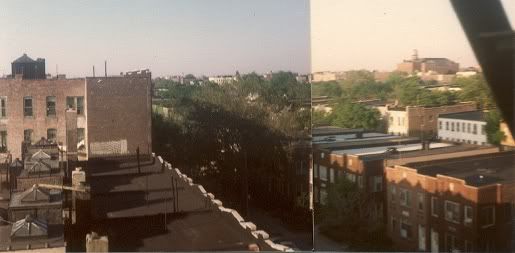
Spring green to me is all the teenage romances launched when the weather took its warmish turn. It's sunshine that lingers longer, my bedroom window flung open as I sat and looked out at the glimmering early-evening city beyond my perch (this very view, in fact):

It's that smell--you know it?--that says leisure...youth...air...winter is done. Love can begin.

In my heart there's a roster of songs that accompanied the intensity of feeling with a new romance back then. That's because I was sitting in that window with big bubble headphones, to soundtrack the reverie. Play any of those songs now, and I'm right back in it, reveling. But there's also a part of me that was made to remember those times. It's the writer, certainly; the fatherless girl, possibly, who sought to cling to someone; and it's definitely the pop-culture maven who marks everything by the sounds, sights, and preoccupations of an era. Moreover, I had the good fortune to choose worthwhile guys, so my memories of them are largely positive. Not to mention sharply etched into my brain. And fueled, luckily, by a trove of photos that I've saved for decades. Teenage fun and abandon captured in a rectangle. Faces I'll never forget--not because I pine, but because I savor.

April heralded the arrival of my beloved spring green, throughout my young years. When I moved to Maine 23 years ago, I lost that heady month. Hereabouts, April's signal colors are mud-brown and sky-gray. When the spring transition arrives in these northern climes, typically in the first or second week of May, your breath is barely drawn to welcome it when--hello!--summertime pushes its way in. This equals tourists, silver flash and gray exhaust of many out-of-state cars, surprising and sudden hot weather, and tourists. It's upheaval, not transition. Less easy to run towards. (Or maybe that's just what adulthood brings, the speeding of time, the loss of reflection...regardless of my relocation.)

I'm impatient for it anyway.

Partial Roster of Nessa's Spring-Green, Headphone-Blasting Songs:
"I Wanna Go to the Sun"—Peter Frampton
"Your Own Special Way"—Genesis
"Lovely to See You"—Bay City Rollers
"Yes It Is"—The Beatles
"A Little Is Enough"—Pete Townshend
"Dreams—Fleetwood Mac
"Love Alone"—Utopia
"Old Brown Shoe"—The Beatles
"And You and I"—Yes
"You"—Tony Banks
"In the Air Tonight"—Phil Collins
"Don't Stop Believin'"—Journey

04 April 2006

Every day

Last year was so crammed full of experiences and emotions that I actually needed a theme song...something to put it all into perspective and make me feel understood every day.

Every day..."Every Day I Have the Blues." That was the song. It so happened that all of my losses concurred with the emergence of the John Mayer Trio as a touring unit. I had seen my mother die, literally. I had presided over the dismantling of my childhood home and placed countless mundane objects in my own house like talismans. Had spoken with everyone Mom loved, all her friends, many of whom had never even known she was sick. Their older-familiar voices made those conversations even more poignant. By June 2005, every nerve ending in my body was frayed.

And so, bruised and saddened, I pounced on the JM3 ticket presales like a tiger uncaged. I scored every show ticket I wanted. And I plotted a four-day woohoooo road trip with my dear friends Lobsta and Rappa.

When the JM3 tour finally rolled up its carpets, I had seen them six times. Five out of those six times, I'd waited for hours in line to be as close to the stage as possible. To say this was wish fulfillment is an understatement--along with the Trio, I have an arms-long list of other bands for whom I gladly would have done this in the past. So JM3 stood in for many thwarted years when I could never have gone off on a toot like this.

Seeing the same rock artist for many days straight is a gush of Almost Famous ennui, combined with I'm-with-the-band hubris. Hotel after hotel after hotel, city upon city upon city, you start to understand the bizarre otherworldliness of being in a touring band. Nothing's rooted. Nothing matters, and what if it did? Except for the stage and everything that happens there. That's it, distilled. The rest is restlessness.

Every Trio show began the same way. John Mayer, usually in a lush velvet jacket and grungy jeans, standing with his back to the audience in front of Steve Jordan's drum kit. No music...just the restless gray roar of a waiting crowd. If you were close enough, you could see that on the darkened stage, Mayer was moving his hips, ever so slightly, to the beat in his head that he was about to explode into. This moment became one of the greatest examples of antici-SAY IT-pation I've ever experienced.

Then--jolt--the song would begin with a hammering blast of two chords, over and over, insistently. Standing in the crowd, a few feet away, the pounding driving beat put shape to my pain. Then Mayer would step up to the mic, breathy and raw at the same time: "Every daaay, every day I have the blues." Oh yes, I'd think, head banging to the beat, I do. You know it. Each night that song plunged me into a blue pool of all my sadness and dire memories, then it pulled me out.

The JM3 arrangement of "Every Day I Have the Blues" moved a traditional blues number onto a different shelf where Pearl Jam and Stevie Ray reside. Ragged around the edges, dissonant, yet with solos slicing sharp and keen. I reveled in that song every time I heard it, that's all I know. And at the last gig in New York, I believed the song's power would fade, because its work here was done.

I was totally wrong about that. The John Mayer Trio just played a gig in Tempe, Arizona...the final spin of the Trio carousel, as it were. Henceforth, Pino Palladino will melt into the Who, Steve Jordan will kick Eric Clapton's rhythm section into the sky, and John Mayer will reassemble himself into John Mayer, solo. As if to announce the new day--and, for me, as if to close the book on a cataclysmic year--the Trio debuted a new arrangement of their signature opening number in Tempe. When I first read about this revision, I sighed, assuming the song would have been denuded, and in the process, made irrelevant to me. Last night my friend Allie linked me to a youtube video of the "Every Day" performance, and I clicked it with a skeptical flinch.

Ah...but instead, the Trio shook out the wrinkles, funked up the backbeat, scrambled the jigsaw, and Mayer rammed in more notes than I ever thought the song could hold. Contrary to its title, "Every Day I Have the Blues" has become an assertion of sinewy joy. A statement: this is why this band exists, to sound just like this. To live.

I needed a new theme song, evidently, and there it is. "Every Day I Have the Blues," and they will not conquer me.

28 March 2006

Nessa's List of Arcane, Obsolete Job Skills

This morning I was pondering the many ways I've made a living over the years, and I realized that I have acquired a bizarre collection of skills, not one of which is practicable or useful in this post-post-modern world. Because many of you reading this were but oocytes when my work life began, I thought I would share the list with you (kinda like, "Gee, Grandma, what DID you do before TV was invented?!" Please note that, in fact, television was invented and adapted into a large, viewable screen size before I was born. However, I did live through the Wizard of Ozian transition from black-and-white to color...and dang it, I still like black-and-white.)

Herewith, the list:

1982: Laundress. Yes, laundress. Every Saturday morning, I was paid $25 for five hours' toil in the basement of a Manhattan restaurant. I washed and dried four loads of tablecloths, napkins, and (no shit) the owner's shirts in silvery industrial machines...and after they were all dry, I had to iron each and every one of them by hand. Which is why, decades later, the palms of my hands are pretty insensate to heat. And why I can still iron a man's shirt like a pro. There's a job skill for the ol' resume.

1982: Supermarket cashier. Polyester three-quarter-sleeved jacket with store logo, a foot pedal to move the groceries forward on the black belt, and here's the real dilly: no scanners. I had to ring up every single itemon a keypad. Throughout that summer, I would wake up in the middle of the night to find my right hand ringing up independent of my conscious mind: 1.99 Grocery, 5.50 HBA, 9.98 Meat, 4.99 Txbl Item....

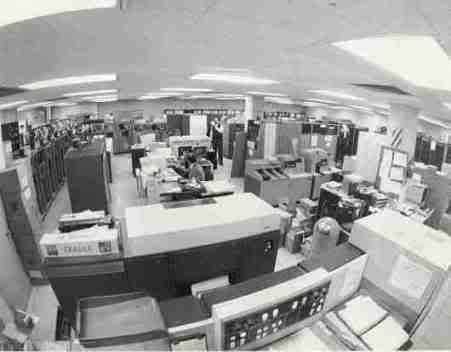
1983: Operations Assistant. I spent a summer working with my older brother and a hilarious crew of co-workers in a Wall Street computer room. We were responsible for data processing financial transactions for numerous high-end firms (geez, now that I think about it, that's scary). The room was a byzantine array of whirring, humming IBM hulks, exactly like this:


It was windowless and glaringly lit, and every day we went through the same exact paces, as dictated by the mainframe's programming. My mind was constantly racing from the monotony...but luckily my co-workers were inventive (they used to make a baseball bat out of rolled-up greenbar paper, and a ball out of a wad of tape, and voila--instant diversion!)

This job taught me how to operate a punch card reader, a 1960s contraption that endured for a surprisingly long time as a data storage and retrieval method:


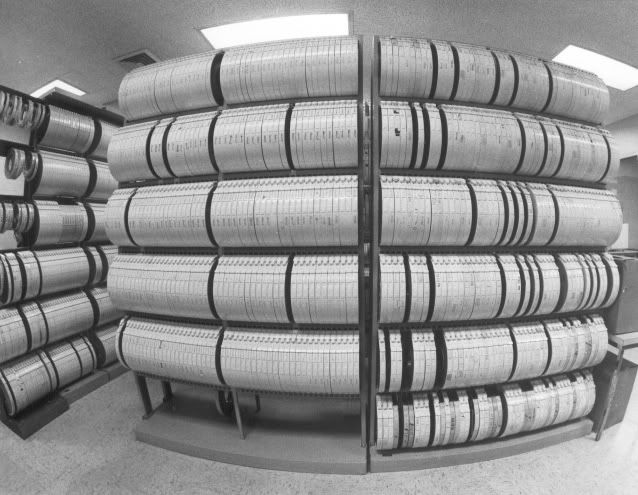
I was also the tape librarian, collecting plastic, circular "scratch tapes" from big tape drives and refiling them in numerical order on massive storage racks:


The awesome thing about this job--besides the spontaneous baseball games--was getting paid more than I'd ever made in my life. I bought scads of records at Tower on 4th Street that summer, plus my brother and I had a crowd of friends who worked downtown, so Friday nights were a guaranteed blowout at the Raccoon Lodge and other Tribeca haunts.

1984: Database developer. Another obsolete computer system--the DEC-10--and another repetitive, summer-long task: catalog every single photo in Bowdoin College's Office of Public Information. I actually had a blast doing this; among the hundreds of photos were 19th century glass negatives, pics of every faculty member as a novice, and relics from the protest-laden 1960s. I still use the archivist skills...only, not on a computer with a tiny black screen and glowing, dot-matrixy orange letters.

1985: Film projectionist. Yup, I was the shadowy figure in the flickering little window-box, high above the theater seats, loading huge film reels onto creaky equipment and hoping my manual transitions from one reel to the next would be seamless. I also ran filmstrips--BOOP!--in classrooms. Doing this job made me feel invisible.

1985: Disc jockey. Two turntables, a microphone, and moi, broadcasting jazz over the airwaves. Bowdoin College had a massive vinyl LP collection, and I never tired of fingering the spines in the shelves and finding new/old music to play. Three years later, the station went digital, and hundreds of LPs were ignominiously disposed of, upended into trashcans. Oh! my heart! I salvaged some, but the station managers chucked them faster than I could rescue them. Heathens.

1985: Telephone operator. Ever see those Movietone films of ladies with a clunky headset, seated at a big console full of plugs and holes? That was me, every weekday lunch hour, when I would cover for the college operator. I developed an operator patois: "MmmmmBowdoinnnnCollege," I would say as I picked up the incoming calls. They'd ask for an extension; I would pull up a thick plug, find the corresponding hole with the extension number, and ram the plug home to connect the callers to their party. And even better--once I plugged in, I had to manually ring the extension with a toggle switch. Once the call ended, the line would emit this irritating errrrrnnnnn noise to remind me to pull out the plug. If I fell behind, the console became a befuddling, crisscrossed maze of flexible wires. It was all very I Love Lucy

1985-86: Secretary. Smith-Corona typewriters, keys jumpy with electrified juice. Liquid paper and Correctype--lots of it. Index cards. And phones with flashing hold buttons shaped perfectly square.

1986-94: Editorial Assistant. Yet another useless computer skill: laying out a tabloid-size newsletter on a minature Macintosh screen. You learn how to scroll, squint, and cross your fingers when you hit "print".


This job also trained me in manual layout of newspaper advertisements, which required use of a waxer: a handheld metal roller with an electric plug. Inside the roller is a block of wax that's heated to sticky goo (which means it's hot as a mofo. See above for iron-acquired hand insensitivity). To do newspaper layouts, you'd scissor little paper images into the desired shape, run the roller over the back of the paper-bit, then press it into place on the master page. 

I am a master of lost arts, of machinery that clunks and whirs, plastics that are hard and inflexible, metals that gleam with the patina of use and the sheen of oil. My fingers have been smudged with typewriter ribbon, reddened by unsafe levels of heat, and numbed with keypad entry. My first dalliance with minimum wage saw me getting $3.25 an hour.

The world turns.

02 March 2006

Sister Grace Agnes

One of the strongest influences in my life, apart from family members, was a woman who routinely bullied and occasionally whapped kids; whose eyes burned with thwarted ambition; whose demeanor was 85 percent sour; whose intentions were simple, if difficult to divine: to elevate her charges whenever and however possible.

You couldn't say that Sister Grace Agnes went about her intentions the right way. In this society, harassing and haranguing students in your classroom is completely unacceptable. Not to mention the open-palmed smacks in the face that she delivered when a student misbehaved.

Moreover, if Sister Grace had taught math, I would not be writing this piece about her. I would have had no reason to seek anything admirable in a tyrant who ruled mathematics, because I despised that subject. But Sister Grace clutched golden keys to the land of my ambition: English grammar. And so, in sixth grade, when I was assigned to her homeroom, I was kind of glad--in a flinching way, because she was definitely the most feared nun at Most Precious Blood School [pause to insert laughter over ironic school name here].

Sister was in her late fifties when she taught us, not much taller than we were, with a dollop of steel-grey hair peeking out of her white-rimmed veil and a piercing gaze. She had a slight limp when she walked, and while she wasn't large in girth, her shoulders were squared off enough to be intimidating. Legend told us, and experience bore out, that she would not hesitate to take a swing at anyone, even the roughest students in the class. And she kept even those kids off-balance, so that order reigned in her classroom. There were times when she smiled or chuckled, and her face would be transformed into someone's daughter, someone's friend. But when that light moment faded, she was all business. As the old-fashioned saying goes, she brooked no foolishness. 

Sister Grace's teaching method never varied from year to year. From Day One, she possessed a set of index cards upon which she had written (in her flawless penmanship) the names of each student. In your hard-bound, black-marble-cover notebook, from Day One, you would transcribe the definitions of every grammatical rule. Sister dictated; you scribbled furiously. And then, you memorized. If you knew what was good for you, that is. Because within a few days of those scribbles, you would be asked to recite the rules she had dictated. "Asked" is not the right verb, actually...demanded. Sister would stand at the front of the classroom with the afore-mentioned index cards held firmly, at viewing distance from her bifocals. And she would bark the surname of a student, randomly, followed by a part of speech. As in: "Martinez. Predicative nominative." And Martinez would be expected to immediately say the definition of that rule, word for word as it was in the notebook. (Only, without the notebook.) "The predicate nominative follows a verb of being and refers back to the subject." (See what a little fear will do for you?)

If Martinez faltered, Sister would flip the card and bark the next name...noting the faltering, so that grades could be rendered later. It was Grammar Boot Camp. And for me, it packed all the thrill of a game show, because I adored the subject matter and strived to know it.

Sister Grace's other major task in sixth grade was teaching us to diagram sentences. Universally, everyone groans about this seemingly pointless exercise, and guess what? I loved it. I was, in fact, exhilirated by it. To me, diagramming was a puzzle that I relished solving, each new sentence a challenge to my burgeoning writer's mind. I never, ever got less than 100 percent on a diagramming test (and we had them at least once a week).

Despite such successes, did I fear this intimidating nun? Indeed, frequently. I dreaded the thought that some minor motion of my hand, some facial expression, some lighthearted glance at another student might cause Sister to barrel down my row and wallop me silly. I saw it happen to many others. My abject terror was such that Sister Grace assigned me a classroom name: Nervous Nellie. Boy, was that fitting for the geeky, jittery kid I was.

So you're wondering where my admiration for this bizarre creature comes in. Well, at the rear of Sister Grace's classroom was a little library. I don't remember any other teachers at Most Precious Blood maintaining a library such as this. It held Scholastic books of the day (nothing too topical, mind you), as well as numerous older books of the Cherry Ames, Student Nurse variety. In a previous blog, I mentioned that my mom resisted my incessant pleas to buy books. "You already have plenty," she'd say. I know now that we were pretty strapped for cash, but it never made sense to me then. Anyway, Sister Grace, for that year, supported my insatiable reading habit by allowing me to take her books home. This was a privilege, and I was extremely careful, never allowing those books to dog-ear or get grease spots at the kitchen table. 

After school, there was a tradition that kids would throng around teachers they liked and walk them down the block towards the avenue, where everyone went separate ways. Someone would volunteer to hold the teacher's bookbag. It wasn't a brown-nose thing, it was more like an informal way to end the school day. Needless to say, Sister Grace had only a smattering of students who ever wanted to walk with her to the convent.

One afternoon, Nervous Nellie found that Sister Grace Agnes had fallen into step alongside her. "You've been reading the books about student nurses," she said to me. A flat statement it was, delivered in her strident voice.

"Y-yes, Sister," I said. "I really like those series." (I did.)

"Are you thinking you might like to be a nurse someday?"

"I don't know...I guess I've thought about it," I said, not accustomed to having adults ask me things like that.

In the slow walk to the convent, Sister proceeded to tell me about how she had wanted to be a nurse as a young woman. (Pre-nun, this was!! The sisters never talked about pre-nun days.) Unfortunately, she contracted polio and became sufficiently weakened that it was deemed she would not be able to handle the rigorous life of a nurse. Thus...teaching.

Thus...the burning ambition that I thenceforth saw in her eyes, thwarted and dulled. 

Thus...my appreciation that she tried, albeit not in the best manner, to at least give her students something: proper English. Which, Lord knows, the streets of Queens were not offering to us on a regular basis.

I found it impossible to defend Sister Grace Agnes to my peers. But many times after that, I walked with her to the convent door. And as the year went along, I came to understand that she had ambitions for me. That was a secret that I held like a jewel. It buoyed me to an excellent high school, and an even better college. Brought me out of Queens, which was a transition I needed to make. More to the point, her support helped me believe in myself. Family members can reassure you all they want; you're never sure if they're just saying that because they love you. But when the woman who rules class 6-305 makes it clear that she knows your worth and expects you to fulfill it, you are persuaded.

Before I launched into this, I googled "Sister Grace Agnes" and actually found a fellow alum of Most Precious Blood who cited her influence:
http://trafcom.typepad.com/blog/2005/11/break_some_rule.html

My fellow alum, Donna, is a writer and an editor. What do you know...Sister Grace nurtured at least two of us. I've e-mailed her, of course, because what are the odds? In the meantime, her blog provides the ultimate capping line for this piece:

"You have to know the rules before you can break them. Amen." 

26 February 2006

The dance

A moment in my day froze today, while I lived it. Paused and assembled into a memory that would last, with all the sensory elements recollected.
 
Peter and I d.j.'d a wedding reception tonight. This was the latest in a series of stressful events in our lives, and getting ready this afternoon, I cracked. (PMS, you are no friend of mine, and my family wishes you would get lost also.) I snapped twice at Pete because he just wasn't doing things at the frenzied robotic pace I was maintaining. Why isn't he dressed? Why aren't the speakers in the van yet?? my mind was ranting. I prefaced one of my outbursts with "I'm realLY PANICKING HERE!" which came out escalating, just like that. Maybe this sounds minor or stupid, but I just don't get mad very often. And never like that at Pete. Even worse, it wasn't really him I was mad at—it was my stress, my nerves, and my eternal penchant for taking on too many things that have honking deadlines and tons of associated details.
 
That wasn't the moment I had in mind, anyway. It's just a mortifying preface moment to the actual one. I never had time to apologize to Pete, that's how busy we were...and my resultant internal discord seemed so at odds with the wedded bliss we were soundtracking in the reception hall. Finally, six hours into the job, the last song slid into the CD deck: "You're Still the One" by Shania Twain. The bride and groom collapsed into the familiar fit-together of a slow-dance, as they'd done about a dozen times already. I stood up to stretch...and when I opened my eyes, in front of me was Peter's extended hand.
 
In the semi-darkness of the d.j.'s corner, we slow-danced. And here's the moment: my face pushed up against his chest. The tweedy jacket texture, that man-scent. And the flood of connection, forgiveness, and gratitude I felt in his arms. We fit together too, his tall-guy chin resting on my head, his hand caressing my neck, mine on his back, low. That moment: our married experiences, compressed into one dance. 
 
They said, "I bet they'll never make it..."
But just look at us holding on,
We're still together, still going strong.
You're still the one I run to,
The one that I belong to,
You're still the one I want for life.
You're still the one that I love,
The only one I dream of,
You're still the one I kiss good night.
 
Writing this, I'm crying for joy, not the first time today. I'm used to crying for others' joy—it's a by-product of providing first-dance music for people whose love shines all around them. Now it's mine, ours, his.
 
Enough writing. He's waiting for me.