Fred Arnold did not make it past eighth grade. He was a scrapper, honed by pick-up hockey on the ice of the Nashwaak River and the competitive pushing of six older brothers whose exploits were always larger than his. (Fred did not envy them their military service, however...he felt eternally fortunate to have been too young for the First World War and too old for the Second.) As he grew up, Fred's mother told him many times that as the seventh son, she believed he had a gift, and he should become a physician. She cited his mathematics ability, his competence, and his good heart. He glowed with her confidence, but somehow, school was not a venue where Fred could fulfill her hopes. His teachers compared him unfavorably to his brothers, and his schoolmates often had better clothing and a calmer home life, all of which Fred resented deeply. Day to day, Fred rebelled enough to have his nose broken against a blackboard at one brutal teacher's hand. Later in life, the tendons of his palms crinkled inwards where teachers had smacked them repeatedly with 12-inch rulers. These childhood flashpoints did not dim his seething determination.
When Fred's mother died--in the midst of his grade 7 school year, and with little forewarning to her youngest son--the die was cast. His already pugnacious persona became hardened and exasperated. He battled his way into grade 8, hated every minute, and jumped off the academic track for good. During that same dreadful year, his father remarried, and Fred left home to live with his beloved uncle, who lived in the same town. It is a grace note in Fred's life that no one intervened in his departure. Even today, to imagine his 12-year-old turmoil is almost unbearable.
The early 20th century was Dickensian in its cruelties. In modern times, "survival of the fittest" conjures abstract evolutionary happenings among lower animals. For our forebears, it was the name of the game. Fred survived, oh you betcha. He left Atlantic Canada for Maine, where a new railroad was enabling unprecedented travel and commerce in the northern counties. In this, he followed in his beloved brother Mel's footsteps. Most recently, Mel had served with bravery as part of the Canadian Expeditionary Force in two theaters of WW1, signing up before his 18th birthday and lying shamelessly about his age. This, too, was in the horrible aftermath of their mother's death...I can almost feel the hot tears behind Mel's eyes, not emerging, as he gritted his teeth and signed on the dotted line for service and sacrifice. What the hell did he have to lose? His mother had been taken just three months prior. His father already showed signs of moving on. What remained but death or glory?
Mel was a signaller in the war. A mustard-gassing in Russia (and multiple medals for bravery) finally convinced him to give up the fight and come home. Thence, he parlayed his war experiences into a career as a railroad telegrapher. As Fred joined him in Maine, Mel taught his eager young brother everything he knew about this most crucial means of communication. The Bangor and Aroostook Railroad hired Fred in the mid-1920s, and he was officially an adult. Courtship, marriage and a newborn followed.
Fred's professional life led him to the Great Northern Paper Company, the largest employer in his newly adopted hometown of Millinocket. He hated leaving the railroad, but a supervisor questioned his integrity over some transaction he'd processed, and Fred bristled. With his newfound sense of adult stability, he cut and ran. That the GNP hired him so readily is a testimony to his evident intellect and assertive personality; in fact, despite his lack of a high school diploma, he never worked on the factory floor, instead taking part in the end-stage aspects of the paper production process.
Fred retired in 1962 as the supervisor of the Finishing Room. He was 58 years old. From that moment until the day he died, he received a monthly pension check and guaranteed health insurance from the GNP and its successor owners. He and his wife lived frugally, but they never wanted for a thing. Both nearly made it to age 90, so their financial comfort is especially noteworthy. Think of it: no stock investments, a house worth $20,000, SSI checks, health plan, pension. That's all. Yet they were provided for by a system that our country shaped carefully as a reaction to the privations of the Great Depression, and the shortages and strifes of two major wars.
Was Fred fulfilled by his work? Well, as his close confidante in later years, I can tell you that tapping out myriad messages on a telegraph set under deadline stress was his greatest professional joy. Sitting at that station desk and waiting for the shadow of a locomotive to cross the window, bearing the fruits of his labors--that was his idea of a happy routine. But Fred also took subsequent pride in the papers he helped make, the men whose careers took place under his supervision, and the tiny town that bustled with work and camaraderie, where literally everybody knew your name.
I think about Fred constantly in these messed-up, terrifying, bewildering economic times. I can see him at his home desk, carefully and competently tending his modest household finances. During my youth, my own mother confronted numerous financial hurdles, and Fred--her father--never failed to provide when asked. Because that's what you do. The fact that he could do it was what he expected after a long, productive work life, faithful to one company. Even moreso: it was the WHY behind his full-time efforts. When local people in a similar situation recently lost their pensions and insurance a few years before retirement, I felt bereft and infuriated on their behalves. Forty years of toil, and now: nothing awaits. The world has changed, you see. Your company does not value you as an individual American anymore. And God forbid your rights as a worker should be valued, protected, and propagated.
Fred, I long to hear your words, in your voice, from your living-room armchair of observation. You would be moved to copious outbursts of fury, and bless you, I know you would be picking up the phone and blasting every representative, every official whose turncoat ways led us to this hour. "This is Fred H. Arnold," you would begin--as you did every time you called anyone to complain about anything. You weren't shy, and you persisted until your way was clear. And you felt that stating your identity at the outset was worthy, that they owed you their attention.
I'm tempted to quote Wordsworth and his "Milton! Thou shouldst be living at this hour." But that's not quite it. I am horrified at the thought of bringing my grandfather back to see this world that is the upside-down-wrong version of what he strove for and achieved.
Still, Wordsworth stated his generation's ire beautifully, so here 'tis. Grampy would have loved to hear me read it to him, the fulfillment of that college education he paid for--the betterment of his descendants always his highest goal.
LONDON, 1802.
Milton! thou should'st be living at this hour:
England hath need of thee: she is a fen
Of stagnant waters: altar, sword and pen,
Fireside, the heroic wealth of hall and bower,
Have forfeited their ancient English dower
Of inward happiness. We are selfish men;
Oh! raise us up, return to us again;
And give us manners, virtue, freedom, power.
Thy soul was like a Star and dwelt apart:
Thou hadst a voice whose sound was like the sea;
Pure as the naked heavens, majestic, free,
So didst thou travel on life's common way,
In chearful godliness; and yet thy heart
The lowliest duties on itself did lay.
Showing posts with label genealogy. Show all posts
Showing posts with label genealogy. Show all posts
03 March 2011

26 February 2011
After the hurricane
(Honestly, I'm not all grim all the time. Not even like 10% of the time. But sad things have happened, and I am driven to write about them...to gain understanding, mastery; to give shape.) So:
It's a famous case. There's a popular movie with an Oscar-winning actor, and a Bob Dylan song beloved and believed by people all over the world. I found out today there's a new autobiography by the man who claims he was falsely accused and framed. Nelson Mandela wrote the foreword.
45 years later, and I still yearn for a woman I can't remember, my grandmother, whose life was tangled up in a dark, evil night, and there destroyed. The details of her wounding and death were horrific; given the subsequent literal hurricane of accusations, court papers, slippery evidence, conflicting testimonies, and raging controversy, Hazel's murder will never be solved. I accept that I will never know who did this to her, and I embrace the peace of that. But today, cnn.com commenters are debating all over again the innocence or guilt of the convicted man. And someone actually posted: "... after all this time, not sure it matters anymore."

What matters, then: Hazel was beautiful, truly. She had a lilting singing voice, coupled with a mischievous smile and a winning personality. She parented lovingly and fiercely, after a childhood of abandonment and poverty. She was mine, and I'll never have her. Needing my grandmother is one of the reasons I embarked on my genealogical journey in 2000. Piece by piece, and never with ease, I've reassembled and claimed her fragmented life story. Dates, names, places, from France to Québec, New England to New Jersey. Found the love, and the sadnesses too. Made my family whole.
The poem I wrote about her a few years ago came out of me like water wrung from a cloth. It needed to happen, but it wrenched. I'm posting it now because this wound keeps getting seared open, and the poem is as close as I can come to wailing: STOP. Let her rest. Let her be Hazel. Give her back to us.
--------------------------------------------------------------
Grandmother, Lost
Fingering the corner of a faded photo,
I find myself in Hazel:
eyes that light and scrinch with grins,
appled cheeks, shy teeth,
chin, softly doubling,
dark wavy hair.
I've been told she feared aging
yet laughed uproariously and kidded often—
sardonic bend of her Jersey voice teasing,
sway of ample hips knowing as she walked away
carrying a loaded tray of food and drinks,
serving at a country club.
Dad kicked us out when I was four months old.
A family in shards, swept up,
discarded; then I was
shielded from everyone sharing my surname,
that lingering verb: Burns.
So Hazel dwelled in handlebars, silver as a mirror,
on the gleaming blue tricycle she'd given me
(only, living in the city, I maybe got to ride it once)—
cool sheen of the handlebars' curve
under my baby-plump palm, a tricycle
hopelessly parked indoors, new black tires
ready to move.
Today I move a smooth mouse, pointing
on the Internet, finding
an image when I search on her name:
the window of the Lafayette Bar and Grill, 1966,
"Rheingold" spelled in neon script
with a bullethole in the upper corner,
glass cracked like a twinkled star.
That's Hazel's bullet, one of five
that pierced her and left her for dead,
blasting from shotguns wielded by strangers.
And I am one of ten grandchildren:
a club that never met.

08 April 2010
M'athair
Until I was 22 years old, I never called anyone Dad. In fact, when I said the word aloud as a kid, it felt weird, like a new word I was supposed to memorize for French class. I cringed like I wasn't pronouncing it correctly...like no one who heard it would understand what I was talking about. "Dad." Gulp, try again. "Dad." Thudding consonants with a short a in the middle. Foreign.
On the first day of kindergarten, I came to realize what an effective social tool this fact could be. Seated at the blue table (bright blue-gingham circle pasted in the center of a cool, smooth wood surface), the assembled kids were offering snippets of their life stories and talking about what their dads did for a living. As always, this irked me. Wait, I thought. Just wait for your chance. And then Warren, at my left, said, "My father is a mechanic."
"I don't have a father," I announced brightly.
Eyes bugged; little voices said, "Huh?" "What?" "You have to have a father!"
"Nope," I said. I savored my big word: "My parents are divorced."
"Oo-ooo-ooh"'s went around the blue table, as divorce was still relatively rare in 1969. My classmates looked at once admiring and wary. I've elicited that facial expression many, many times since. Call it a pioneer's survival skill. Maybe even a badge of honor. It's who I was for years and years: a searching, fatherless child.
Mom tried not to talk about him--and eventually, my stepfather didn't allow her to. Any discussions Mom and I had about my father were furtive and gloomy, and there was never a chance to bring it up again later; each conversation was self-contained, so I had to get my questions in immediately. The factoids I gleaned about his drinking, his anger, and his irresponsibility as a parent were no more enlightening than the National Enquirer. Meanwhile, my stepfather's comments about my father were pretty clear: "That asshole has no right to see you. I'd kick the shit out of him if he came anywhere near here."
I called my stepfather by his first name, because calling him "Dad" would have been like bestowing "Your Highness" on Miss USA; the two just don't equate. He had no clue that, deep in the recesses of my bedroom closet, I hoarded the single photo album that showed my parents together, sometimes even looking happy. My mother had no idea how often I plied the album's yellowing paper pages, onto which scores of black-and-white photos had been rubber-cemented. The album smelled like a lost past, keen and musty. The photos still shone, crisply focused by my father's photographic skill. Rarely, his own image surfaced in there, and I scrutinized it like a detective for signs of similarity to mine. So close to the face in the photo...as if I could start a conversation with it.
We never saw my father's family members; they were cut out of my life before I was old enough to know who they were. I have a gauzy memory of seeing a crowd of them at some event; I recently surmised that it must have been after my paternal grandmother's funeral in New Jersey. Tall, talking adults drifting around a kitchen, far above my bewildered two-year-old head; a screen door and blurry green trees beyond it...pressing my nose up against the screen. I remember watching a cousin playing on a swingset outside, but my tentative attempt to join her was interrupted by a bee scouting the yard. I was outlandishly afraid of bees, so I stayed inside. My father must have been there, but I had no reason to recognize him amongst all the similarly featured Burnses. People spoke loudly as the afternoon dragged on, and I cringed as I always did at adult voices being raised.
So, I was consigned to rummaging in the closet, shooting glances over my shoulder to make sure no one opened my bedroom door. Carefully pulling out the album--Mom actually put these pictures in a nice one, not some cheapo plastic thing. This album had a leathery cover, black, with gold embossed on it. The pages were supple and organized chronologically. Once, I guess Mom figured she would want to look back.
I'm the only one who wanted to look back, as it turned out. Do I look like him? Would I have liked him? ran through my head as I flipped through the precious five pages of pictures where my father appeared (the rest of the album was taken up by baby pictures of my brother, a bonanza of images that dwindled as the marriage listed sideways...and then the album goes to Kodacolor and I'm born. A few pages to cover five years of my life, then...done).
Try as I might, I could never connect the black-and-white pictures with 3-D reality. In them, Dad's smiles and gestures are frozen. He's not a whole person, just miniature moods on film that don't change. (Mostly good moods, when you looked.) And he was young...goofily, affectlessly young. I suspected that I looked like him, but I never had anyone in the room to second me on that. And whenever I asked my maternal grandparents (in the safe haven of Maine), as kindly as they were, they would immediately rush in to reassure me. "No, dahlin', you don't look anything like him. You don't want anything to do with his people. You are just you, that's all, and we are so glad of that."
They wanted me to feel loved and cherished...I don't think they realized I was yearning for them to link me up with the Burnses. And knowing how much they disliked my father (in fact, had never liked him from the first meeting, and continued to compile a list of offenses that would not let any positive feelings creep in)...well, I did not want to challenge them further, forcing them to remember him too vividly.
I did come upon one other fragment of my father's life. The third drawer in my bedroom dresser was stuffed with papers and documents: the legalese story of my family's life. (In a three-room apartment, no one truly has a room or even a dresser to herself.) Left to my own devices, I adored pawing through that drawer, even then showing signs of a budding obsession with genealogy. Awkwardly shoved into the space was a folded stack of photostatic copies (dimly grey, shiny, smelly pre-Xeroxes). Mom must have copied these pages in some office setting, probably before I was born. They were poems--a meticulous, lofty manuscript. The faint typewriterly words seethed with anger and intellectual disdain. My father was a poet. This revelation came to me after my own writer's voice had made itself known, rendering the discovery ever more magical. For years, I puzzled over his works, which were denser than T.S. Eliot in places, positively Joycean in others. I had no idea what this man was ranting on about, but he was difficult to cleave to; his casually dropped Gaelic and classical references were not exactly bread to Gretel. It was not until high school that I could begin to decipher the verse-heavy, word-laden works. Quickie summary: that residual anger my mom was carting around about him? He flung his own back at her, fueled by a wounded youth and penchant for infidelity. This poetry, even as it became more comprehensible, still left me at sea.
Some years later, the fall after I graduated from college, my mom called me--I lived in Maine full time by then. She said, completely apropos of nothing, "Do you want to speak to your father?"
For a bewildered second I thought she was about to hand the phone to him or something--after all, the stepfather was long gone. But, no, she had decided to track his number down because I was an adult now, and it was up to me what I went and did with it. This was pre-Internet--it's a miracle she found him at all. In California, no less. (And what a classic Mom thing to do: practical, emotionless, just thrusting the ball at me: here.) Shall I define mind-blown for you? Mom's question pretty much clinches it. I practically swayed. To this day I can still picture the room I was in as I clutched the phone and let Mom's deed fully dawn on me, breaking across my mental shore in waves.
I might have waited one night before I made the fateful phone call...maybe. Despite my terrified nerves, uncertainties bubbling in my brain, wild imaginings about how wrong this could go...I punched in the numbers Mom gave me. He came to the phone immediately and I swear to you, I knew his voice. The man of poetic, liquored fury had been domesticated and sobered by his third wife, and was now a wry, productive eighth-grade English teacher (talk about penance!). Thus began a relationship that closed so many books, opened my mind, and made me whole. Also, it placed into my mouth a word I had always deserved: Dad. And in his mouth, a word that made a girl of me: "Sweetheart."
We called each other weekly and wrote epic letters to bring each other up to speed on lives that had never intersected. We exchanged pictures--expanding my visions of him a hundred times over, and giving him something tangible of his daughter. Peter was new in my life then, and Dad wholeheartedly approved. This had not been the case with all of my relatives, who warmed to my eventual spouse a little more slowly. Dad knew personally how the right person could alter the course of your life, leading you to better choices and happier days (and nights). Not for nothing did my own sobriety coincide with all of these events.
After five years of phone calls and the aforementioned barrage of correspondence, we finally met in 1992. I was pregnant with a son, and Dad had just been diagnosed with cancer. Being together in-person was suddenly urgent--and how fortunate, indeed, that I could make the trip, as it was the first and last time we ever spent time together. Dad's treatments had just begun, and he was vigorous and engaged by my visit. For my part, I tried to adjust to the alien landscape of Los Angeles in February, and hugged this man as often as I could. Our stomachs--mine swelled with six months of fetus, and his swelled with 56 years of living--would bump, and we'd giggle. We spent hours tucked into plaid-cushioned chairs across from one another, talking, comparing notes, absorbing. Every night, I puttered in his kitchen and made dinner Reifsnyder-style, since his treatments mandated extra nutrition.
One afternoon, Dad told me about the day of my birth, and that may have meant more to me than anything else he said in our time together, because it was vivid and true and connected me to him as never before.
It was the day after the Beatles had arrived in New York City, and Manhattan was swirling with screaming hordes and bemused journalists. The city winter cold was charged with an undeniable cultural electricity. Meanwhile, in a delivery room on the Upper West Side, my father's head swirled with a vicious red-wine hangover, the result of a Friday night house party my parents had hosted. The hospital staff insisted he wear a surgical mask while he watched Mom give birth to me; now, the wine fumes steamed from his mouth up to his nose, recycling, fueling the hangover. Still, he hung in there and witnessed my emergence, gamely.
Joy glimmered into the pain when Mom's female obstetrician displayed me to Dad immediately after my delivery, flawed and bloodied and human, his daughter. Dr. Ammann had allowed Dad to bypass the smoke-choked waiting room, the soundproof glass, the tightly blanketed infant in nurse's arms and the empty congratulations. This was rarely done in that era--I know Dad must have really wanted to be there. Perhaps we even bonded, in the parlance of latter-day infant researchers. Did his eyes--bleary above the mask line, but proud--meet my steady newborn gaze, that deceptive moment of lucidity before the long first nap sets in? Did he reach for me? Enraptured by his words, I forgot to ask him.
I had been conceived in a spirit of detente between my parents, I was told. A one-last-try for the marriage, an upswell of love and loving. But despite that auspicious beginning in the delivery room, Dad was out of my life within weeks. Vanished. By his own confused, conflicted, alcoholic choice. And my family unit sealed up behind him, to stanch the pain.
Had I never found Dad and gotten to know him, I know I would never have become fully adult. Some part of me would have stayed girl...a keening, unanswered invitation. Robert Leo McAllister Burns: I look like him, I laugh like him, and I write like him. It's my pride and distinction to call him Dad.
On the first day of kindergarten, I came to realize what an effective social tool this fact could be. Seated at the blue table (bright blue-gingham circle pasted in the center of a cool, smooth wood surface), the assembled kids were offering snippets of their life stories and talking about what their dads did for a living. As always, this irked me. Wait, I thought. Just wait for your chance. And then Warren, at my left, said, "My father is a mechanic."
"I don't have a father," I announced brightly.
Eyes bugged; little voices said, "Huh?" "What?" "You have to have a father!"
"Nope," I said. I savored my big word: "My parents are divorced."
"Oo-ooo-ooh"'s went around the blue table, as divorce was still relatively rare in 1969. My classmates looked at once admiring and wary. I've elicited that facial expression many, many times since. Call it a pioneer's survival skill. Maybe even a badge of honor. It's who I was for years and years: a searching, fatherless child.
Mom tried not to talk about him--and eventually, my stepfather didn't allow her to. Any discussions Mom and I had about my father were furtive and gloomy, and there was never a chance to bring it up again later; each conversation was self-contained, so I had to get my questions in immediately. The factoids I gleaned about his drinking, his anger, and his irresponsibility as a parent were no more enlightening than the National Enquirer. Meanwhile, my stepfather's comments about my father were pretty clear: "That asshole has no right to see you. I'd kick the shit out of him if he came anywhere near here."
I called my stepfather by his first name, because calling him "Dad" would have been like bestowing "Your Highness" on Miss USA; the two just don't equate. He had no clue that, deep in the recesses of my bedroom closet, I hoarded the single photo album that showed my parents together, sometimes even looking happy. My mother had no idea how often I plied the album's yellowing paper pages, onto which scores of black-and-white photos had been rubber-cemented. The album smelled like a lost past, keen and musty. The photos still shone, crisply focused by my father's photographic skill. Rarely, his own image surfaced in there, and I scrutinized it like a detective for signs of similarity to mine. So close to the face in the photo...as if I could start a conversation with it.
We never saw my father's family members; they were cut out of my life before I was old enough to know who they were. I have a gauzy memory of seeing a crowd of them at some event; I recently surmised that it must have been after my paternal grandmother's funeral in New Jersey. Tall, talking adults drifting around a kitchen, far above my bewildered two-year-old head; a screen door and blurry green trees beyond it...pressing my nose up against the screen. I remember watching a cousin playing on a swingset outside, but my tentative attempt to join her was interrupted by a bee scouting the yard. I was outlandishly afraid of bees, so I stayed inside. My father must have been there, but I had no reason to recognize him amongst all the similarly featured Burnses. People spoke loudly as the afternoon dragged on, and I cringed as I always did at adult voices being raised.
So, I was consigned to rummaging in the closet, shooting glances over my shoulder to make sure no one opened my bedroom door. Carefully pulling out the album--Mom actually put these pictures in a nice one, not some cheapo plastic thing. This album had a leathery cover, black, with gold embossed on it. The pages were supple and organized chronologically. Once, I guess Mom figured she would want to look back.
I'm the only one who wanted to look back, as it turned out. Do I look like him? Would I have liked him? ran through my head as I flipped through the precious five pages of pictures where my father appeared (the rest of the album was taken up by baby pictures of my brother, a bonanza of images that dwindled as the marriage listed sideways...and then the album goes to Kodacolor and I'm born. A few pages to cover five years of my life, then...done).
Try as I might, I could never connect the black-and-white pictures with 3-D reality. In them, Dad's smiles and gestures are frozen. He's not a whole person, just miniature moods on film that don't change. (Mostly good moods, when you looked.) And he was young...goofily, affectlessly young. I suspected that I looked like him, but I never had anyone in the room to second me on that. And whenever I asked my maternal grandparents (in the safe haven of Maine), as kindly as they were, they would immediately rush in to reassure me. "No, dahlin', you don't look anything like him. You don't want anything to do with his people. You are just you, that's all, and we are so glad of that."
They wanted me to feel loved and cherished...I don't think they realized I was yearning for them to link me up with the Burnses. And knowing how much they disliked my father (in fact, had never liked him from the first meeting, and continued to compile a list of offenses that would not let any positive feelings creep in)...well, I did not want to challenge them further, forcing them to remember him too vividly.
I did come upon one other fragment of my father's life. The third drawer in my bedroom dresser was stuffed with papers and documents: the legalese story of my family's life. (In a three-room apartment, no one truly has a room or even a dresser to herself.) Left to my own devices, I adored pawing through that drawer, even then showing signs of a budding obsession with genealogy. Awkwardly shoved into the space was a folded stack of photostatic copies (dimly grey, shiny, smelly pre-Xeroxes). Mom must have copied these pages in some office setting, probably before I was born. They were poems--a meticulous, lofty manuscript. The faint typewriterly words seethed with anger and intellectual disdain. My father was a poet. This revelation came to me after my own writer's voice had made itself known, rendering the discovery ever more magical. For years, I puzzled over his works, which were denser than T.S. Eliot in places, positively Joycean in others. I had no idea what this man was ranting on about, but he was difficult to cleave to; his casually dropped Gaelic and classical references were not exactly bread to Gretel. It was not until high school that I could begin to decipher the verse-heavy, word-laden works. Quickie summary: that residual anger my mom was carting around about him? He flung his own back at her, fueled by a wounded youth and penchant for infidelity. This poetry, even as it became more comprehensible, still left me at sea.
Some years later, the fall after I graduated from college, my mom called me--I lived in Maine full time by then. She said, completely apropos of nothing, "Do you want to speak to your father?"
For a bewildered second I thought she was about to hand the phone to him or something--after all, the stepfather was long gone. But, no, she had decided to track his number down because I was an adult now, and it was up to me what I went and did with it. This was pre-Internet--it's a miracle she found him at all. In California, no less. (And what a classic Mom thing to do: practical, emotionless, just thrusting the ball at me: here.) Shall I define mind-blown for you? Mom's question pretty much clinches it. I practically swayed. To this day I can still picture the room I was in as I clutched the phone and let Mom's deed fully dawn on me, breaking across my mental shore in waves.
I might have waited one night before I made the fateful phone call...maybe. Despite my terrified nerves, uncertainties bubbling in my brain, wild imaginings about how wrong this could go...I punched in the numbers Mom gave me. He came to the phone immediately and I swear to you, I knew his voice. The man of poetic, liquored fury had been domesticated and sobered by his third wife, and was now a wry, productive eighth-grade English teacher (talk about penance!). Thus began a relationship that closed so many books, opened my mind, and made me whole. Also, it placed into my mouth a word I had always deserved: Dad. And in his mouth, a word that made a girl of me: "Sweetheart."
We called each other weekly and wrote epic letters to bring each other up to speed on lives that had never intersected. We exchanged pictures--expanding my visions of him a hundred times over, and giving him something tangible of his daughter. Peter was new in my life then, and Dad wholeheartedly approved. This had not been the case with all of my relatives, who warmed to my eventual spouse a little more slowly. Dad knew personally how the right person could alter the course of your life, leading you to better choices and happier days (and nights). Not for nothing did my own sobriety coincide with all of these events.
After five years of phone calls and the aforementioned barrage of correspondence, we finally met in 1992. I was pregnant with a son, and Dad had just been diagnosed with cancer. Being together in-person was suddenly urgent--and how fortunate, indeed, that I could make the trip, as it was the first and last time we ever spent time together. Dad's treatments had just begun, and he was vigorous and engaged by my visit. For my part, I tried to adjust to the alien landscape of Los Angeles in February, and hugged this man as often as I could. Our stomachs--mine swelled with six months of fetus, and his swelled with 56 years of living--would bump, and we'd giggle. We spent hours tucked into plaid-cushioned chairs across from one another, talking, comparing notes, absorbing. Every night, I puttered in his kitchen and made dinner Reifsnyder-style, since his treatments mandated extra nutrition.
One afternoon, Dad told me about the day of my birth, and that may have meant more to me than anything else he said in our time together, because it was vivid and true and connected me to him as never before.
It was the day after the Beatles had arrived in New York City, and Manhattan was swirling with screaming hordes and bemused journalists. The city winter cold was charged with an undeniable cultural electricity. Meanwhile, in a delivery room on the Upper West Side, my father's head swirled with a vicious red-wine hangover, the result of a Friday night house party my parents had hosted. The hospital staff insisted he wear a surgical mask while he watched Mom give birth to me; now, the wine fumes steamed from his mouth up to his nose, recycling, fueling the hangover. Still, he hung in there and witnessed my emergence, gamely.
Joy glimmered into the pain when Mom's female obstetrician displayed me to Dad immediately after my delivery, flawed and bloodied and human, his daughter. Dr. Ammann had allowed Dad to bypass the smoke-choked waiting room, the soundproof glass, the tightly blanketed infant in nurse's arms and the empty congratulations. This was rarely done in that era--I know Dad must have really wanted to be there. Perhaps we even bonded, in the parlance of latter-day infant researchers. Did his eyes--bleary above the mask line, but proud--meet my steady newborn gaze, that deceptive moment of lucidity before the long first nap sets in? Did he reach for me? Enraptured by his words, I forgot to ask him.
I had been conceived in a spirit of detente between my parents, I was told. A one-last-try for the marriage, an upswell of love and loving. But despite that auspicious beginning in the delivery room, Dad was out of my life within weeks. Vanished. By his own confused, conflicted, alcoholic choice. And my family unit sealed up behind him, to stanch the pain.
Had I never found Dad and gotten to know him, I know I would never have become fully adult. Some part of me would have stayed girl...a keening, unanswered invitation. Robert Leo McAllister Burns: I look like him, I laugh like him, and I write like him. It's my pride and distinction to call him Dad.
10 February 2010
The Hands
They were the hands of a worker. A laundress, maybe, or a housekeeper. She always lamented how short and ruddy her fingers were, as she pushed on the emerald and opal rings that she loved to wear. Her knuckles were formidable, and the gold bands had to be slid over them just so. The rest of Maryann's skin was palest white with scatterings of Irish freckles, but her hands were reddened.
Facing a long row of white piano keys split by shadow lines and minor black rectangles, Maryann's hands became muscular, precise tools. She had a finger spread that spanned an octave without strain. Her left hand brought bass chords to life in accurate sync with the melody. And she was able to inject softness, nuance, and emotion along with the emphasis. Her hands were made to speak; they were servants to the spirit of jazz music. She realized this before she was 10 years old, in fact: the tunes of popular American song were destined to pour through her hands as entertainment for others. No need for sheet music; she could hear it and reproduce it. Maryann surrendered to that knowledge, transporting herself to a place of balance and peace whenever she played. Her life beyond the smooth wood box of a piano was often dissonant, as though she repeatedly and suddenly became a stranger in the face of everyday events...but the piano was her harbor.
She would gladly have forfeited attending smalltown parties in her youth, but there was an expectation that she would play for the gatherings, and Maryann was very good at living up to her responsibilities. Small talk made her uneasy, and although she had lifelong female friends who always included her in their fun, Maryann could never shake the feeling of being apart. The call to "Play something for us, Maryann!" was a relief even as it was a nuisance (because the partygoers would inevitably tell her what to play, demandingly, and then only half-listen as their small talk and smoking raved on). In the Northern Lights Class of 1950 yearbook, they nicknamed her "Paderewski".
Her graduation gift from her parents was an extravagance that befitted her nickname: a baby grand piano. Dark sepia wood, with lighter swirls of grain...beyond furniture, it was practically a planet in her parents' modest living room. An anchor in the harbor, you might say. An enticement, even...a plea for this golden only child not to leave.
It didn't work. She departed easily, plunging into the swelter of New York City summer. Maryann's hands ventured to nightclubs on Manhattan's fabled 52nd Street, where larger and even noisier crowds listened as the redhead coaxed the standards to swing and emote. Places like the Hickory House and the Embers, whose names evoked steak and smoke. By day, she was a radio station page, to pay her rent at the YWCA. Her nights glittered and simmered. Maryann found a community of fellow-travelers in the city...players from nowherevilles all over the world, for whom a musical instrument was equally effortless and all-consuming. Their lingua franca was their coolness, their ability to instinctively bend music so that it became something more shining than its original form.
She began dating a fellow-traveler named Bob Burns, late of the storied US Navy Band, a drummer whose conflicts and demons made Maryann's moments of social estrangement seem tame. He burned to play like she did (surname pun ruefully acknowledged), but there were gaps in his groove. Maybe his methodical intellect blocked him from giving over to the art. Bob ached to possess Maryann as his wife, perhaps to absorb some of her light, but ultimately, he snuffed it out with mundane duties. It was the 1950s, and Maryann was well aware of what she was expected to do: make this man a home, give birth to children. Wear an apron and have dinner ready. Their early married life in an urban apartment was not so dull, if the black-and-white photos are to be believed. But Maryann was certainly not sitting in at nightclubs on Wednesdays at midnight, and Bob had become a university student on the GI Bill...living out his own version of what-was-expected.
Bob and Maryann's jazz world must always be viewed through the amber glow of alcohol. It may well have enabled their muses to emerge fully flowered, without inhibitions, but as their marriage encompassed parenthood and salaries, it robbed them of any sense of settled contentment. Bob became bitterly angry, his tirades insensible. When infidelity was added to his list of domestic sins, Maryann scooped up her young children, returned north to her small town of birth, and left New York to him. The baby grand had awaited her in its living room berth, and it slowly reawakened her soul.
I have staccato memories of early childhood which linger far more vividly than most people's. My mother's elusive persona, her tether to a piano while my grandparents guided me through toddlerhood...it's all right at the fringes of my psyche, shards of places and events. Eventually, our family returned triumphantly to New York City, as Maryann got the gig of a lifetime: playing piano every night onstage in a hit Broadway show, Cabaret. Every night, some older woman--my nana, a babysitter--tucked me in while Maryann performed and brought home the bacon. I never minded her absence, but I jealously guarded her presence whenever I got it.
I stlll recall preschool afternoons when she would fill our apartment living room with the sound of the Steinway upright she'd purchased for herself. I stood to the right of her bench, eye-level to the keys, wanting to be as close as possible. I could stand there all day, watching the blur and pause of her hands. The music, I remember, was surprisingly louder from that vantage point, resonating through the wood. The wood itself had a scent, a deep sweetness. I knew, without being told, that my mother was phenomenally talented; that the songs she played were just as good as the jazz LPs in rotation on the stereo in that same room: Count Basie, Marian McPartland, Oscar Peterson, Horace Silver. Maryann's mantra to her children differed from other mothers'; it was "Sssssh. Sssssh. Listen."
As Maryann's hands ranged over the keys, larger-than-life in that proximity, I was inevitably seized with a temptation: to strike a key with my childish index finger. I wanted to be swept up into the music, become part of it, not just her bystander. I could never deny the urge, and soon my hand would approach; my finger would choose a key. Most of the time the note was a lemon against whatever song she was playing. I knew that, could hear the note's high-pitched awfulness...but I would plink it again and again, listening to how it stood out, alone on a rich tapestry of beauty. Maryann did not stop me.
Among my genealogical treasures are the receipts for her baby grand and her Steinway, fluttering pink reminders of her time, her sound, what made her free.
Facing a long row of white piano keys split by shadow lines and minor black rectangles, Maryann's hands became muscular, precise tools. She had a finger spread that spanned an octave without strain. Her left hand brought bass chords to life in accurate sync with the melody. And she was able to inject softness, nuance, and emotion along with the emphasis. Her hands were made to speak; they were servants to the spirit of jazz music. She realized this before she was 10 years old, in fact: the tunes of popular American song were destined to pour through her hands as entertainment for others. No need for sheet music; she could hear it and reproduce it. Maryann surrendered to that knowledge, transporting herself to a place of balance and peace whenever she played. Her life beyond the smooth wood box of a piano was often dissonant, as though she repeatedly and suddenly became a stranger in the face of everyday events...but the piano was her harbor.
She would gladly have forfeited attending smalltown parties in her youth, but there was an expectation that she would play for the gatherings, and Maryann was very good at living up to her responsibilities. Small talk made her uneasy, and although she had lifelong female friends who always included her in their fun, Maryann could never shake the feeling of being apart. The call to "Play something for us, Maryann!" was a relief even as it was a nuisance (because the partygoers would inevitably tell her what to play, demandingly, and then only half-listen as their small talk and smoking raved on). In the Northern Lights Class of 1950 yearbook, they nicknamed her "Paderewski".
Her graduation gift from her parents was an extravagance that befitted her nickname: a baby grand piano. Dark sepia wood, with lighter swirls of grain...beyond furniture, it was practically a planet in her parents' modest living room. An anchor in the harbor, you might say. An enticement, even...a plea for this golden only child not to leave.
It didn't work. She departed easily, plunging into the swelter of New York City summer. Maryann's hands ventured to nightclubs on Manhattan's fabled 52nd Street, where larger and even noisier crowds listened as the redhead coaxed the standards to swing and emote. Places like the Hickory House and the Embers, whose names evoked steak and smoke. By day, she was a radio station page, to pay her rent at the YWCA. Her nights glittered and simmered. Maryann found a community of fellow-travelers in the city...players from nowherevilles all over the world, for whom a musical instrument was equally effortless and all-consuming. Their lingua franca was their coolness, their ability to instinctively bend music so that it became something more shining than its original form.
She began dating a fellow-traveler named Bob Burns, late of the storied US Navy Band, a drummer whose conflicts and demons made Maryann's moments of social estrangement seem tame. He burned to play like she did (surname pun ruefully acknowledged), but there were gaps in his groove. Maybe his methodical intellect blocked him from giving over to the art. Bob ached to possess Maryann as his wife, perhaps to absorb some of her light, but ultimately, he snuffed it out with mundane duties. It was the 1950s, and Maryann was well aware of what she was expected to do: make this man a home, give birth to children. Wear an apron and have dinner ready. Their early married life in an urban apartment was not so dull, if the black-and-white photos are to be believed. But Maryann was certainly not sitting in at nightclubs on Wednesdays at midnight, and Bob had become a university student on the GI Bill...living out his own version of what-was-expected.
Bob and Maryann's jazz world must always be viewed through the amber glow of alcohol. It may well have enabled their muses to emerge fully flowered, without inhibitions, but as their marriage encompassed parenthood and salaries, it robbed them of any sense of settled contentment. Bob became bitterly angry, his tirades insensible. When infidelity was added to his list of domestic sins, Maryann scooped up her young children, returned north to her small town of birth, and left New York to him. The baby grand had awaited her in its living room berth, and it slowly reawakened her soul.
I have staccato memories of early childhood which linger far more vividly than most people's. My mother's elusive persona, her tether to a piano while my grandparents guided me through toddlerhood...it's all right at the fringes of my psyche, shards of places and events. Eventually, our family returned triumphantly to New York City, as Maryann got the gig of a lifetime: playing piano every night onstage in a hit Broadway show, Cabaret. Every night, some older woman--my nana, a babysitter--tucked me in while Maryann performed and brought home the bacon. I never minded her absence, but I jealously guarded her presence whenever I got it.
I stlll recall preschool afternoons when she would fill our apartment living room with the sound of the Steinway upright she'd purchased for herself. I stood to the right of her bench, eye-level to the keys, wanting to be as close as possible. I could stand there all day, watching the blur and pause of her hands. The music, I remember, was surprisingly louder from that vantage point, resonating through the wood. The wood itself had a scent, a deep sweetness. I knew, without being told, that my mother was phenomenally talented; that the songs she played were just as good as the jazz LPs in rotation on the stereo in that same room: Count Basie, Marian McPartland, Oscar Peterson, Horace Silver. Maryann's mantra to her children differed from other mothers'; it was "Sssssh. Sssssh. Listen."
As Maryann's hands ranged over the keys, larger-than-life in that proximity, I was inevitably seized with a temptation: to strike a key with my childish index finger. I wanted to be swept up into the music, become part of it, not just her bystander. I could never deny the urge, and soon my hand would approach; my finger would choose a key. Most of the time the note was a lemon against whatever song she was playing. I knew that, could hear the note's high-pitched awfulness...but I would plink it again and again, listening to how it stood out, alone on a rich tapestry of beauty. Maryann did not stop me.
Among my genealogical treasures are the receipts for her baby grand and her Steinway, fluttering pink reminders of her time, her sound, what made her free.
22 March 2008
Proud
Yesterday was one of the proudest days of my life, both maternally and personally. Let me explain....
This weekend, I am a con mom. I've traveled to Boston with Zoe as she makes her debut at the Artists Alley of Anime Boston (http://www.animeboston.com/)--a huge annual gathering of the tribes (i.e., tens of thousands of costumed, role-playing aficionados of Japanese manga and anime, 98% teenaged). Artists Alley is a selling-place for amateur artists, and Zoe has been working for months on her wares...posters, buttons, postcards, all featuring her art. Yesterday morning the piece de resistance arrived here from the printer's: Mahou Shounen, an actual 20-pp booklet (she calls it a mini-manga) with her own original story, characters, and inventive, accomplished artwork. The moment that we huddled together over the box and extracted the first book is engraved on my memory. (I meant to keep that first copy, but later on I showed it to another con mom in the hotel elevator and she bought it on the spot!) So we finally have a published person in our family. Self-published, in this case, but that doesn't detract at all from the achievement therein...and in fact, it allowed us a great deal of quality control and editorial say-so. I'm so proud of my artist-girl!
Originally, we were planning to send Zoe down here solo. This past week, though, it became abundantly clear that mountains of details and the heft of her baggage were going to defeat that idea. Hence, my (expensive but necessary) presence in Boston. While we are plunked right in the middle of the city's tastiest retail district, I really wasn't looking forward to a weekend of H&M envy (you know, that wistful cruising through stores whose merchandise is priced above my head and sewn below my size?) A little pre-trip websurfing, though, reassured me that I would have another option: the New England Historic Genealogical Society is a few blocks away from here.
So I spent yesterday afternoon in my element, idly paging through dusty books in search of nuggets. To access this library, it's most cost-effective to join the Society, so I signed up onsite for an annual membership. (Speaking of proud, this means I'm now a member of two noteworthy genea-orgs...the other being the Association of Professional Genealogists. Ooh, I quiver just writing that!)
I perused books and basked in the researchiness of it all, then came back to the hotel. After awhile, I logged onto the NEHGS' website to look over their databases, which the membership coordinator had mentioned to me earlier. Turns out that therein lurked the final pieces of my most resistant genea-puzzle: the early marriage days of my great-grandparents, Blanche Guillotte and William Paquin. Peter has brought me to so many town halls and archives trying to recapture the stories of their lives...but this was a "brick wall" with shame and discord for mortar, so breaking through it has been near-impossible. Their daughter, my Auntie Winnie, sat with me for an interview 10 years ago (which I blessedly have on tape), but she remembered little of the father who'd abandoned them, and the mother who did the same by tossing her five kids into orphanages when money got tight. Winnie gave me surreal half-tales, and I've spent the ensuing decade giving bones to that flesh, slowly but determinedly.
The NEHGS database brought me closure, as I finally, finally found Blanche and William's marriage record (under William's alias, William J. Benson), and then, amazingly, the birth record of their first child, a stillborn son, two months after the wedding day. Winnie remembered hearing about that son and even visiting his grave as a little girl, but she knew nothing about when or where he was born. Well, the "when" is actually a key part of the story, for he was obviously conceived out of wedlock, and he was born and died, tragically, on Christmas Day 1908.
What bitterness and grief did that engender? How did such a horrible loss on a usually joyous holiday mark Blanche and William for life? And did it feel, deep down, as though their union might be cursed? because from that point on, the stories I've heard suggest that it was.
In a brief blog setting, I can't begin to tell you the sadnesses I've discovered on both sides of my dad's family. Untimely deaths, poverty, alcoholism, thwarted dreams, loveless marriages. But I can tell you that I have been driven, urged, pushed to seek and find. I realized fairly early into this that no one else in my family was going to be able to find the facts and stitch the quilt. I don't mean that to be self-aggrandizing; it's just that for most of my life leading up to these discoveries, I've been unwittingly assembling a series of skill sets that I now can deploy to find the answers. Somewhere inside me, I know now that that those answers want to be found. Last night's puzzle pieces convinced me of that. The ancestors speak, many genealogists say. They guide us. What I would add is: They want us to know them and understand them. To tell their stories. Their sadnesses and life lessons must never be for naught.
I am proud to know them.
This weekend, I am a con mom. I've traveled to Boston with Zoe as she makes her debut at the Artists Alley of Anime Boston (http://www.animeboston.com/)--a huge annual gathering of the tribes (i.e., tens of thousands of costumed, role-playing aficionados of Japanese manga and anime, 98% teenaged). Artists Alley is a selling-place for amateur artists, and Zoe has been working for months on her wares...posters, buttons, postcards, all featuring her art. Yesterday morning the piece de resistance arrived here from the printer's: Mahou Shounen, an actual 20-pp booklet (she calls it a mini-manga) with her own original story, characters, and inventive, accomplished artwork. The moment that we huddled together over the box and extracted the first book is engraved on my memory. (I meant to keep that first copy, but later on I showed it to another con mom in the hotel elevator and she bought it on the spot!) So we finally have a published person in our family. Self-published, in this case, but that doesn't detract at all from the achievement therein...and in fact, it allowed us a great deal of quality control and editorial say-so. I'm so proud of my artist-girl!
Originally, we were planning to send Zoe down here solo. This past week, though, it became abundantly clear that mountains of details and the heft of her baggage were going to defeat that idea. Hence, my (expensive but necessary) presence in Boston. While we are plunked right in the middle of the city's tastiest retail district, I really wasn't looking forward to a weekend of H&M envy (you know, that wistful cruising through stores whose merchandise is priced above my head and sewn below my size?) A little pre-trip websurfing, though, reassured me that I would have another option: the New England Historic Genealogical Society is a few blocks away from here.
So I spent yesterday afternoon in my element, idly paging through dusty books in search of nuggets. To access this library, it's most cost-effective to join the Society, so I signed up onsite for an annual membership. (Speaking of proud, this means I'm now a member of two noteworthy genea-orgs...the other being the Association of Professional Genealogists. Ooh, I quiver just writing that!)
I perused books and basked in the researchiness of it all, then came back to the hotel. After awhile, I logged onto the NEHGS' website to look over their databases, which the membership coordinator had mentioned to me earlier. Turns out that therein lurked the final pieces of my most resistant genea-puzzle: the early marriage days of my great-grandparents, Blanche Guillotte and William Paquin. Peter has brought me to so many town halls and archives trying to recapture the stories of their lives...but this was a "brick wall" with shame and discord for mortar, so breaking through it has been near-impossible. Their daughter, my Auntie Winnie, sat with me for an interview 10 years ago (which I blessedly have on tape), but she remembered little of the father who'd abandoned them, and the mother who did the same by tossing her five kids into orphanages when money got tight. Winnie gave me surreal half-tales, and I've spent the ensuing decade giving bones to that flesh, slowly but determinedly.
The NEHGS database brought me closure, as I finally, finally found Blanche and William's marriage record (under William's alias, William J. Benson), and then, amazingly, the birth record of their first child, a stillborn son, two months after the wedding day. Winnie remembered hearing about that son and even visiting his grave as a little girl, but she knew nothing about when or where he was born. Well, the "when" is actually a key part of the story, for he was obviously conceived out of wedlock, and he was born and died, tragically, on Christmas Day 1908.
What bitterness and grief did that engender? How did such a horrible loss on a usually joyous holiday mark Blanche and William for life? And did it feel, deep down, as though their union might be cursed? because from that point on, the stories I've heard suggest that it was.
In a brief blog setting, I can't begin to tell you the sadnesses I've discovered on both sides of my dad's family. Untimely deaths, poverty, alcoholism, thwarted dreams, loveless marriages. But I can tell you that I have been driven, urged, pushed to seek and find. I realized fairly early into this that no one else in my family was going to be able to find the facts and stitch the quilt. I don't mean that to be self-aggrandizing; it's just that for most of my life leading up to these discoveries, I've been unwittingly assembling a series of skill sets that I now can deploy to find the answers. Somewhere inside me, I know now that that those answers want to be found. Last night's puzzle pieces convinced me of that. The ancestors speak, many genealogists say. They guide us. What I would add is: They want us to know them and understand them. To tell their stories. Their sadnesses and life lessons must never be for naught.
I am proud to know them.
16 March 2008
Who Am I?
Last night, the Criterion Theatre hosted a Celtic Music night. I am on the board of this theatre and I felt a certain responsibility to attend, let's say (because, while I'm a huge consumer of Irishness in general, I sometimes feel that the whole Celtic subculture can be a shade inauthentic. Sometimes even exploitative.) Lydia agreed to accompany me because one of her favorite things to do, inexplicably, is clean the theatre after an event. :: shrug :: As a board member, I'd be remiss not taking advantage of that. Plus, I have so few opportunities to bask in Lydia's personality.
Much to my amazement, this evening rocked me to the core, serving up revelation after revelation about myself, my genealogy, my daughter, and my theatre. The artists were Jennifer Armstrong (http://www.jenniferarmstrong.com/) and Ladies of the Lake (http://www.ladiesofthelakemusic.com/). At no point did either act strike an inauthentic nerve--they were interpreting the songs and instruments of the past, not shaming them. And they were all incredibly skilled multi-musicians. I learned:
1) Bagpipes and tin whistles are guaranteed to make me cry. (More about that soon.)
2) Lydia absolutely loves this kind of music, and identifies strongly with female musicians.
3) After the Jacobite Wars of the 18th century, the English banned bagpipes, the Gaelic language, and other cultural mainstays. Because bagpipe melodies had always been conveyed from master to learner as sung phrases--with words standing in for notations--the instrument endured through this ban and was readopted immediately after the ban was lifted, with the songs still handed down intact. Scots women singing as they went about their chores helped sustain the melodies.
4) The Criterion Theatre is inspirational, period. I've been dedicated to it for months now, but as a venue, it's a powerful and historical house.
When I got home from the show, I was a little crazed to capture all the emotions I was hauling around. Scrapbooking? poetry? blog? Couldn't choose. Finally, between 2 a.m. and ten minutes ago, two poems emerged to bring peace to my insides. Indulge me, if you will. It feels so good to have named these feelings that are as familiar as bread.
At the Celtic Music Concert
Bagpipes and tin whistle
make me cry
for people I will not meet
but whose breath I know,
whose blood is mine.
At some point,
every single family line
had this moment:
the ship, the coast,
the home behind,
the uneasy sea,
the unknown ahead.
My French soul,
my Irish heart:
jigs and reels
tug me home
to heal.
------------------------------
Who Am I?
I grew up in the 1970s
when heritage was optional,
when families whose ancestors had only just arrived
chose “Colonial” as a kitchen décor—
not seeing the irony in copper-clad pots
and faux hearths.
Marooned on the desert island
of a tiny Queens apartment,
my mother, brother and me:
sole survivors of a shipwrecked marriage--
another union of Irish and French,
litany of arguments and poverty and drunkenness
relived not conquered we never learn if we don’t grasp the past
They didn’t grasp the past.
Thus I was robbed of my tongues:
mumbled Québécois French
of rosaries and gossip,
crooned Gaelic
of mothers at the sideboard and fathers stumbling home.
Rootless in a neighborhood of new-arrived ethnics.
Strangely blinded to me, myself, I.
And so my search began.
Denied faces, stories and names,
discouraged from connecting,
I quested for them far and wide.
Thirty years later, I am here to report:
I have found them
in scrawled handwritten records, city directories,
and photo albums of distant cousins.
Their souls reach to me.
I feel their troubles, their joys, their births, their journeys
keenly, deeper than my heart, where mothering takes hold.
Genealogy is their embrace,
a compulsion for reunion.
(I will go anywhere to be in a room full of cousins.)
Grass and farm and factory and church.
It is standing where they were baptized
(I have)
and kneeling where they were buried (yes)
my knees dampened by eternal sod.
I am not in Queens anymore.
-----------------------------
Indeed.
Much to my amazement, this evening rocked me to the core, serving up revelation after revelation about myself, my genealogy, my daughter, and my theatre. The artists were Jennifer Armstrong (http://www.jenniferarmstrong.com/) and Ladies of the Lake (http://www.ladiesofthelakemusic.com/). At no point did either act strike an inauthentic nerve--they were interpreting the songs and instruments of the past, not shaming them. And they were all incredibly skilled multi-musicians. I learned:
1) Bagpipes and tin whistles are guaranteed to make me cry. (More about that soon.)
2) Lydia absolutely loves this kind of music, and identifies strongly with female musicians.
3) After the Jacobite Wars of the 18th century, the English banned bagpipes, the Gaelic language, and other cultural mainstays. Because bagpipe melodies had always been conveyed from master to learner as sung phrases--with words standing in for notations--the instrument endured through this ban and was readopted immediately after the ban was lifted, with the songs still handed down intact. Scots women singing as they went about their chores helped sustain the melodies.
4) The Criterion Theatre is inspirational, period. I've been dedicated to it for months now, but as a venue, it's a powerful and historical house.
When I got home from the show, I was a little crazed to capture all the emotions I was hauling around. Scrapbooking? poetry? blog? Couldn't choose. Finally, between 2 a.m. and ten minutes ago, two poems emerged to bring peace to my insides. Indulge me, if you will. It feels so good to have named these feelings that are as familiar as bread.
At the Celtic Music Concert
Bagpipes and tin whistle
make me cry
for people I will not meet
but whose breath I know,
whose blood is mine.
At some point,
every single family line
had this moment:
the ship, the coast,
the home behind,
the uneasy sea,
the unknown ahead.
My French soul,
my Irish heart:
jigs and reels
tug me home
to heal.
------------------------------
Who Am I?
I grew up in the 1970s
when heritage was optional,
when families whose ancestors had only just arrived
chose “Colonial” as a kitchen décor—
not seeing the irony in copper-clad pots
and faux hearths.
Marooned on the desert island
of a tiny Queens apartment,
my mother, brother and me:
sole survivors of a shipwrecked marriage--
another union of Irish and French,
litany of arguments and poverty and drunkenness
relived not conquered we never learn if we don’t grasp the past
They didn’t grasp the past.
Thus I was robbed of my tongues:
mumbled Québécois French
of rosaries and gossip,
crooned Gaelic
of mothers at the sideboard and fathers stumbling home.
Rootless in a neighborhood of new-arrived ethnics.
Strangely blinded to me, myself, I.
And so my search began.
Denied faces, stories and names,
discouraged from connecting,
I quested for them far and wide.
Thirty years later, I am here to report:
I have found them
in scrawled handwritten records, city directories,
and photo albums of distant cousins.
Their souls reach to me.
I feel their troubles, their joys, their births, their journeys
keenly, deeper than my heart, where mothering takes hold.
Genealogy is their embrace,
a compulsion for reunion.
(I will go anywhere to be in a room full of cousins.)
Grass and farm and factory and church.
It is standing where they were baptized
(I have)
and kneeling where they were buried (yes)
my knees dampened by eternal sod.
I am not in Queens anymore.
-----------------------------
Indeed.
06 December 2007
Legacy
My family tree program is called Legacy. On it, I have logged 44 men named Joseph "Joe" Pinette. One of them is my direct ancestor: my nana's father, whom I never knew, but whose life was made vivid to me through the storytellings of those who knew him well.
I met this Joe Pinette after I had attended a funeral for a different first cousin in 2003. I'd been conducting family tree research for three years, and was beginning to get to know Mom's generation over time. Joe Pinette was not at the funeral, but his wife and sister were. I will never forget the moment when they approached me after the service, both of them literally peering into my face, squinting--and then one of them exclaimed, "Now, she's a Pinette! Just look at the eyes!" We talked at the luncheon, and Joe's wife told me that he would be interested in my genealogy, and would be calling me.
His voice was gentle and manly all at once. There was an endearing catch to it, an occasional throat-clearing. The friendliness streamed right through the phone. He said that he had some information to share with me: Joe was the eldest of six siblings, and there had been eight others from his father's first marriage. Mom always had trouble relaying their names to me; now I was hearing it from the source. Did he ever have information for me! But quickly, my connection to Joe Pinette transcended mere data. In fact, it took my breath away.
We had something in common, Joe and I. Something strong as steel, invisibly massive, life-destroying and life-affirming all at once: We had both grown up in households where upheaval, alcohol, and shame reigned. We knew, deep in our souls, what it felt like to go to school and excel, forcing ourselves to behave in an upstanding and amiable way--while hiding a strange, distorted homelife that no one in our school worlds could possibly comprehend. We had both transcended. We had, in fact, soared. Our parents' marriages had blown apart, causing financial hardship and chaos; our fathers had been horrible drunks; and yet we completed higher education, we chose solid careers, and at the age of 25, we each married our soulmates.
Talking to Joe brought me to a place of level solace in my genealogy. It felt like a unified circle to meet someone of a completely different generation who knew, deep down, what it had taken to survive. And Joe, like me, retained immense fondness for all of his family members regardless of mistakes they had made or pain they'd caused--even for the small town that had stepped deftly, sometimes indifferently around his family's secrets.
Soon, we visited Millinocket together, that small town--my mom's hometown, too. We took a walk around a part of town called Tin Can Alley. This was where the poorest families lived, too many kids to feed properly, and in many cases with a dirt floor. This was where Joe grew up. He brought his street to life--told me about a family who'd lived across the street over there, others over here; showed me the low fence that had demarcated his world. Joe was not allowed to go past it as a little boy, so he stood at it and watched cars, other houses, other people, wondering. Behind him would have been a house with two toddlers and a baby...noise and conflict and worry. Here, he stood alone, a five-year-old already beyond his age in what he saw and knew.
We left that street and walked the half-block distance to the river that divides Millinocket. In Joe's youth, the Penobscot was not a clean river, as the paper mill discharged effluent into it routinely. There was undoubtedly a foul smell, and sometimes, unusual colors swirling in the ripples and current. Joe reminisced about goofing off, walking along the river with his pals as an older boy--and as he said that, we found ourselves standing underneath an old apple tree.
Joe looked up with a grin and saw ripened red apples hanging there. He joyfully reached up and plucked one and explained that for a hungry kid from Tin Can Alley, this tree was one of the best spots to visit. And then he ate the apple with a satisfied smile.
Joe was like a grandfather, father, uncle, and friend all in one. I knew instantly that I was loved by him, and he inspired that same devotion in me. This afternoon, his wife Gloria, who has been married to him for 52 years, since she was a girl of 18, called to let me know that Joe died a few hours ago.
My tears are sharp and insistently welling. You see, in the past 15 years, I have lost a grandfather, a father and mother, a treasured uncle, and a lifelong best friend, all of whom I am still grieving. And now, the man who helped me to sustain those feelings and connections has joined them...after giving me so much of himself. I can tell you that Joe knew how much he gave me emotionally, because that's the connection we had.
And my genealogy--that never-ending, joyful journey of discovery and familiarity--henceforth I dedicate to him.
God bless you, Joe, beyond the fence.

08 May 2007
The Diamond Anniversary
On May 8, 1932, a 35-year-old woman prepared for her wedding. A wedding she never expected to have, which resulted from a love story she never expected to be living. Her intended was 28 years old, a Canadian who had moved to her small Maine town eight years ago. You could say they were a study in contrasts: Fred was 5-foot-9, the very definition of strapping.

Whereas Theresa (always called Tut) was 5-foot-2 in her shoes. Even in her 30s, she was as adorable and diminutive as a doll.

Tut's temperament was doll-like, too…cheery, loving, and devoted. Fred--well, Fred was devoted to her, there was no question of that. But impatient! oh, never could anyone become exasperated like him. Not angry, not mean…just sputtery and annoyed. Tut smiled to herself whenever she thought of it. This man endeared himself to her with every fluster, every bluster. She calmed Fred, soothed him, and humored him. He had never smiled the way that she made him smile.
But married, she never expected. Fred started courting Tut when he was barely 21. How many times had she shaken her red-haired head and redirected him to a younger single woman in town? She thought Fred charming and insistent, but just a little misguided. Because Tut's devotion was to her parents. As their youngest, she had pledged that she would never leave home. Six siblings had left before her, married, and produced some two dozen children among them--all of whom cherished their Aunt Tutty for her uncomplicated generosity and young spirit. But really, Tut stayed behind for an unspoken reason that caused her pain, alarm, and concern in a mixed jumble: her parents' relationship was frayed, if not ruined completely.
Mama had always relied on her four daughters for house-tending and chores…even for cooking. With Mama now in her seventies, Tut was left to manage the household. What's worse, Mama held a seething grudge against her husband for the loss of their first home to foreclosure, two decades before. Tut adored her papa, who was temperamentally more like her than anyone else in the entire family. Papa was a peacemaker, an oasis of calm. Mama's fiery Irish ways may have drawn him irresistibly in their youth, but now she threatened to overwhelm him with spite. Tut served as their bridge, and for love of both of them, she would never leave.
Fred knew all of this. Years prior, he had heard it in conversation with Tut (as well as her friends, who privately mourned the spinster path she was on). Then, Fred gradually got to know her family. He saw the jagged dynamics in person. And he made a simple statement to the beautiful woman he wanted to marry: "I will never take you away. If you want to live with your parents, I'll do that."
Tut let herself fall in love with him at that moment. But she didn't let on, right away. Fred's desire, his adoration was almost too much for her to bear. Whenever she looked in the mirror, she saw a woman eight years his senior. What kind of existence would this be for a young man in his twenties, the prime of his life? Why, at her age, she probably wouldn't even be able to bear him one child, let alone the many that her sisters had borne.
On May 8, 1932, Theresa adjusted her hair nervously in that same mirror. She wore a modest dress, not fancy wedding attire. Fred was a Methodist, and Tut was devoutly Catholic. For this reason, the wedding was to be held in the rectory of the church: a non-event, meant to deflect attention. Her sister and brother-in-law would serve as witnesses. No guests, no rice, no toasts, no extravagance. Just two people--opposites, attracted--in a small town.
Make that three people. Inside her that day, Tut nurtured a new life--the hidden fact of a pregnancy. Her lifelong modesty makes it impossible to imagine the moment that she gave in to Fred's advances. In a boxy old car? Unthinkable. In her parents' house? Never. In the rooming house where Fred lived sparsely? Doubtful. The place is not important, anyway. Somehow, in the winter of 1932, Fred had convinced Tut. And at the age of 35, she must have asked herself, what was there to lose, really?
No one in Millinocket, Maine, would have been surprised at the subsequent wedding of Fred and Tut. There was nothing abrupt about it; they had been dating for four years solid. Surely their acquaintances rejoiced, having known for years what a perfect couple they made. And her nieces and nephews clung to Fred's lanky frame as though he were already their uncle. Therefore, the baby that Tut carried on May 8 remained a closely held secret. Instead, a few weeks after the priest pronounced them man and wife, Tut and Fred shared joyful news with family and friends that made sense in the timeline: now, they were expecting.
Tut's parents allotted the newlyweds the upstairs of their old, austere house. Tut, who had worked all of her adult life as a gregarious telephone operator, gave up her job and took an even more active role in her parents' daily lives. Fred worked long hours as a railroad telegrapher to support them.
Some months later, the trees were bare, the winds grew cold, and the birth of their baby was nearing--substantially sooner than anyone would have thought. In a masterstroke of plotting, Tut was sent south on the Bangor and Aroostook Railroad to visit her sister Nellie in Augusta. There, Tut awaited her confinement, which came "prematurely" (Fred told the folks back home). Her sister was undoubtedly in on the ruse. In Augusta, on November 27, 1932, Tut delivered a full-term baby girl.
Perhaps Tut would have been better off delivering a preemie. Her tiny pelvis struggled with the birthing, and in the days afterwards, she experienced intestinal difficulties that threatened her life. At one point, the doctor admonished Fred: "Don't ever get her pregnant again." He visibly blanched, nodding his assent.
These events of 75 years ago are part of my DNA. The baby girl was my mother, Maryann. Tut and Fred were my beloved grandparents, from whom I learned about marital love, attraction, respect, and cooperation. It is nearly impossible to explain how safe and cherished I felt in their company--it was beyond a parenting relationship, into something spiritual, a glow that suffused me.
It wasn't until my young adulthood that I learned the full story surrounding this wedding day, and the secret they harbored throughout the years. As the puzzle pieces fell into place, I understood why they never, ever celebrated their anniversary, why they had no wedding pictures, no wedding memories. And as I contemplated all of these events on this year's anniversary--which I choose to commemorate, despite the fact that both Fred and Tut are both deceased--I couldn't help but wonder at the contrast between their surreptitious wedding day, and their lifelong, deep-rooted, inspiring love for each other. In my life, I've met maybe a dozen married couples whose bond and friendship is immediately, tangibly obvious. I compare all of them to my grandparents, who showed me that first.

How sad that the day these loving people were married brought them guilt and shame. How triumphant that they stayed together for life, and never let that submerged secret spoil what they had. My mother's birth, after the complications were cleared, fulfilled both of them in a way I don't think they had anticipated. And while I know they ached for more children, Fred would never have risked losing his sweet wife. Instead, when their two grandchildren arrived, they shared all of that long-held parenting energy with my brother and me. For that, I owe them everything.
Through all of the tumult and nerves, 75 years ago, I can see a moment in the rectory--maybe when the priest was droning from a text in front of him, maybe when the plain gold bands were exchanged--when Fred looked at Tut, caught her eye, and smiled that mischievous and satisfied smile that only she could elicit. And at that moment, I know she smiled right back. Her misgivings had been foolish. He was the one.
An important footnote to this story: up until tonight, I had never seen a photograph of my grandparents' wedding day. I decided to flip through my digital archives to illustrate this story--I have many images of them, just not of their wedding.
Two years ago, my cousin Earle e-mailed me some images, and those were among the files I looked at tonight. I'm very fond of one of them, which appears below. Ever since Earle sent it, I've puzzled over it: why are Nana and Grampy standing there so awkwardly, on the right? Who are the two people with them? Where are they, anyway?

In a bolt of clarity that any genealogist will understand, I suddenly realized tonight that this is the only surviving wedding picture. They are standing on a hillside: that's right across the street from Millinocket's Catholic church. I know that hill like the back of my hand. The two people on the left? That's the witnesses, Eugene and Essie.
First I felt driven to write about their wedding day, and then, I saw it. The ancestors speak to us, that's all I can tell you. And tonight, their diamond anniversary, they led me to this.

Whereas Theresa (always called Tut) was 5-foot-2 in her shoes. Even in her 30s, she was as adorable and diminutive as a doll.

Tut's temperament was doll-like, too…cheery, loving, and devoted. Fred--well, Fred was devoted to her, there was no question of that. But impatient! oh, never could anyone become exasperated like him. Not angry, not mean…just sputtery and annoyed. Tut smiled to herself whenever she thought of it. This man endeared himself to her with every fluster, every bluster. She calmed Fred, soothed him, and humored him. He had never smiled the way that she made him smile.
But married, she never expected. Fred started courting Tut when he was barely 21. How many times had she shaken her red-haired head and redirected him to a younger single woman in town? She thought Fred charming and insistent, but just a little misguided. Because Tut's devotion was to her parents. As their youngest, she had pledged that she would never leave home. Six siblings had left before her, married, and produced some two dozen children among them--all of whom cherished their Aunt Tutty for her uncomplicated generosity and young spirit. But really, Tut stayed behind for an unspoken reason that caused her pain, alarm, and concern in a mixed jumble: her parents' relationship was frayed, if not ruined completely.
Mama had always relied on her four daughters for house-tending and chores…even for cooking. With Mama now in her seventies, Tut was left to manage the household. What's worse, Mama held a seething grudge against her husband for the loss of their first home to foreclosure, two decades before. Tut adored her papa, who was temperamentally more like her than anyone else in the entire family. Papa was a peacemaker, an oasis of calm. Mama's fiery Irish ways may have drawn him irresistibly in their youth, but now she threatened to overwhelm him with spite. Tut served as their bridge, and for love of both of them, she would never leave.
Fred knew all of this. Years prior, he had heard it in conversation with Tut (as well as her friends, who privately mourned the spinster path she was on). Then, Fred gradually got to know her family. He saw the jagged dynamics in person. And he made a simple statement to the beautiful woman he wanted to marry: "I will never take you away. If you want to live with your parents, I'll do that."
Tut let herself fall in love with him at that moment. But she didn't let on, right away. Fred's desire, his adoration was almost too much for her to bear. Whenever she looked in the mirror, she saw a woman eight years his senior. What kind of existence would this be for a young man in his twenties, the prime of his life? Why, at her age, she probably wouldn't even be able to bear him one child, let alone the many that her sisters had borne.
On May 8, 1932, Theresa adjusted her hair nervously in that same mirror. She wore a modest dress, not fancy wedding attire. Fred was a Methodist, and Tut was devoutly Catholic. For this reason, the wedding was to be held in the rectory of the church: a non-event, meant to deflect attention. Her sister and brother-in-law would serve as witnesses. No guests, no rice, no toasts, no extravagance. Just two people--opposites, attracted--in a small town.
Make that three people. Inside her that day, Tut nurtured a new life--the hidden fact of a pregnancy. Her lifelong modesty makes it impossible to imagine the moment that she gave in to Fred's advances. In a boxy old car? Unthinkable. In her parents' house? Never. In the rooming house where Fred lived sparsely? Doubtful. The place is not important, anyway. Somehow, in the winter of 1932, Fred had convinced Tut. And at the age of 35, she must have asked herself, what was there to lose, really?
No one in Millinocket, Maine, would have been surprised at the subsequent wedding of Fred and Tut. There was nothing abrupt about it; they had been dating for four years solid. Surely their acquaintances rejoiced, having known for years what a perfect couple they made. And her nieces and nephews clung to Fred's lanky frame as though he were already their uncle. Therefore, the baby that Tut carried on May 8 remained a closely held secret. Instead, a few weeks after the priest pronounced them man and wife, Tut and Fred shared joyful news with family and friends that made sense in the timeline: now, they were expecting.
Tut's parents allotted the newlyweds the upstairs of their old, austere house. Tut, who had worked all of her adult life as a gregarious telephone operator, gave up her job and took an even more active role in her parents' daily lives. Fred worked long hours as a railroad telegrapher to support them.
Some months later, the trees were bare, the winds grew cold, and the birth of their baby was nearing--substantially sooner than anyone would have thought. In a masterstroke of plotting, Tut was sent south on the Bangor and Aroostook Railroad to visit her sister Nellie in Augusta. There, Tut awaited her confinement, which came "prematurely" (Fred told the folks back home). Her sister was undoubtedly in on the ruse. In Augusta, on November 27, 1932, Tut delivered a full-term baby girl.
Perhaps Tut would have been better off delivering a preemie. Her tiny pelvis struggled with the birthing, and in the days afterwards, she experienced intestinal difficulties that threatened her life. At one point, the doctor admonished Fred: "Don't ever get her pregnant again." He visibly blanched, nodding his assent.
These events of 75 years ago are part of my DNA. The baby girl was my mother, Maryann. Tut and Fred were my beloved grandparents, from whom I learned about marital love, attraction, respect, and cooperation. It is nearly impossible to explain how safe and cherished I felt in their company--it was beyond a parenting relationship, into something spiritual, a glow that suffused me.
It wasn't until my young adulthood that I learned the full story surrounding this wedding day, and the secret they harbored throughout the years. As the puzzle pieces fell into place, I understood why they never, ever celebrated their anniversary, why they had no wedding pictures, no wedding memories. And as I contemplated all of these events on this year's anniversary--which I choose to commemorate, despite the fact that both Fred and Tut are both deceased--I couldn't help but wonder at the contrast between their surreptitious wedding day, and their lifelong, deep-rooted, inspiring love for each other. In my life, I've met maybe a dozen married couples whose bond and friendship is immediately, tangibly obvious. I compare all of them to my grandparents, who showed me that first.
How sad that the day these loving people were married brought them guilt and shame. How triumphant that they stayed together for life, and never let that submerged secret spoil what they had. My mother's birth, after the complications were cleared, fulfilled both of them in a way I don't think they had anticipated. And while I know they ached for more children, Fred would never have risked losing his sweet wife. Instead, when their two grandchildren arrived, they shared all of that long-held parenting energy with my brother and me. For that, I owe them everything.
Through all of the tumult and nerves, 75 years ago, I can see a moment in the rectory--maybe when the priest was droning from a text in front of him, maybe when the plain gold bands were exchanged--when Fred looked at Tut, caught her eye, and smiled that mischievous and satisfied smile that only she could elicit. And at that moment, I know she smiled right back. Her misgivings had been foolish. He was the one.
An important footnote to this story: up until tonight, I had never seen a photograph of my grandparents' wedding day. I decided to flip through my digital archives to illustrate this story--I have many images of them, just not of their wedding.
Two years ago, my cousin Earle e-mailed me some images, and those were among the files I looked at tonight. I'm very fond of one of them, which appears below. Ever since Earle sent it, I've puzzled over it: why are Nana and Grampy standing there so awkwardly, on the right? Who are the two people with them? Where are they, anyway?

In a bolt of clarity that any genealogist will understand, I suddenly realized tonight that this is the only surviving wedding picture. They are standing on a hillside: that's right across the street from Millinocket's Catholic church. I know that hill like the back of my hand. The two people on the left? That's the witnesses, Eugene and Essie.
First I felt driven to write about their wedding day, and then, I saw it. The ancestors speak to us, that's all I can tell you. And tonight, their diamond anniversary, they led me to this.
20 October 2006
Meeting Ellen
There's a lot of paternalism about genealogy. The surnames that motivate most family historians are paternal--understandably so, since those names stay the same (well, nearly, given the vicissitudes of spelling and immigration). Male decisions seem to have motivated most of the migratory shifts that make my genealogy what it is-the choices that brought French, Irish, German, English, Welsh, etc. etc. all together to ultimately produce me and Peter. When you input "occupation" for an ancestor, you're adding in an array of arcane pursuits: carpenter, farmer, miner, cigar roller, paper maker, railroad station agent--but usually the women's are pretty basic: "keeping house" was the nineteenth-century census shorthand for being a mother and a wife. I always picture those beleaguered 1800s women clutching a broom as the census taker enters the house. Yup, there she is, keeping house...just like all the other women on this block. Then the census taker scribbles it in the occupation box with a knowing sigh. I then force myself to comprehend what those women's occupations meant: tending home and hearth for a dozen or more children, preparing meals over an actual fire, sewing clothing, darning, washing everything in sight, tending to injuries, worrying, probably pregnant again, dispensing love in a harsh world.
If you've read this blog for awhile, you already know that I'm a major grandmother fan. So when I started out mining data for family history purposes, my motivation was actually much more maternal than it was paternal. Both my grampy and my dad had lost their mothers suddenly and tragically, and they talked about them in vivid ways. Who were these women? Where did they come from?
It's been six years now since I set my mind, my heart, and my computer to the task of gathering my family--and Pete's--into a full-blown databased entity. Six years of meet-ups with excited cousins...weepy moments in musty record rooms when the piece of data confirms a family legend...long, lonely nights of data entry, the sounds of my household swirling behind me as I type and type and type...triumphant print-outs that show my progress.
And last night, I met my mother's mother's mother's mother. Ellen Finn, of County Cork, Ireland.
Well, I knew about her before. But a key piece of photographic evidence seems to indicate that now, I have seen her at three stages of her life:

The image on the right was just given to me by an elder cousin who stated that this was his grandmother, Ellen Finn. And the other two images had previously been given to me by cousins who shrugged and said, "I don't know who this is. Maybe you can figure it out."
Before I met Ellen photographically, I had assembled her life story from family lore and stark data. She was one of three (if not four) siblings in her family to emigrate from a famine-stricken location to, of all places, northern Maine. She made this journey by way of the Baie des Chaleurs, which curves around the northern portion of New Brunswick, Canada. Ellen arrived in Maine circa 1851, around age 17. Within the year she had married my great-great-grandfather, William Emmett Brown, also a recent Irish immigrant. They established a household that overlooked a shimmering lake encircled by pines and birches and maples...not a Vacationland lake, mind you, but a lake teeming with fish to feed a family. Then, Ellen's husband set about defining the town government structure of what became Eagle Lake, Maine. He was also a healer (both faith- and medicine-based), and took frequent journeys with a horse and a buggy full of remedies to southern Maine and Massachusetts, where presumably people paid him to feel better from rheumatism, pleurisy, dropsy, hysteria, and other ailments of the era.
Ellen, true to census form, kept house while William roamed. She bore him at least 10 children. I believe that she wielded a broom fiercely, and probably took a few swipes at that dreamer husband of hers when he got a wild idea about traveling south again.
Eventually, William opened Eagle Lake's first pharmacy, which apparently brought some level of prosperity because Ellen got a servant. In fact, some of my living cousins are the children of the young maid named Delia who took care of the Brown household. Delia was about 14 when she started that job; she was 15 when one of Ellen and William's sons took her for his bride. (For a glimpse of turn-of-the-century mores, please note that he was 25. And that in their wedding picture, he looks dashing and daring, and she looks blue-eyed-pretty and a little stunned.)
Delia always told her children that Ellen was fiery. That she had a thick Irish brogue, which even applied to French phrases like Baie des Chaleurs (which Ellen referred to as theBay dee Chaloor.) Probably Ellen's stiff demeanor came from a lifetime of sacrifices. She left County Cork and never saw her parents or her homeland again. She adapted to a place that was freezing cold for much of the year, where 98% of the people were native French speakers, and where her husband was out-and-about in pursuit of business, politics, and, bizarrely, the instinct to heal. She lost a number of children in her lifetime, including her youngest son, who was forced to flee west when a local girl accused him of getting her pregnant. The son, Edmund, swore it was not his child. Ellen and her children rallied behind him and shipped him off to Minnesota, where Ellen's brother Thomas resided. Ellen must have lamented his departure terribly...for just one year prior, her husband had died.
Here's something else I have learned about Ellen: she had a soft side. Maybe she didn't want us to know that--I mean, look at the way she glares out of those photos that bring her to us. But what betrayed her was her beautiful singing voice. Numerous grandchildren remembered being held in Ellen's arms in a rocking chair, while she sang to them in Gaelic. Some reported that Ellen had aspired to be a professional singer, before the boat came and hauled her away to northern Maine for the rest of her days. I feel certain that her lilting voice is what endeared her to William Emmett Brown, the dreamer who needed a practical partner.
Perhaps the baby in her arms, above, was one of the grandchildren whose night fears she soothed with a clear and lovely voice. Keeping house, indeed, for all of us who descend from her.
09 October 2006
Nonagenarians
I'm done with the word "old". To the best of my ability, I'm going to try to avoid it. It's a judgement, it's a distancing and a defense mechanism, it's unfair.
Thank you so much to everyone who commented on last night's blog. I was comforted and heartened by your words.


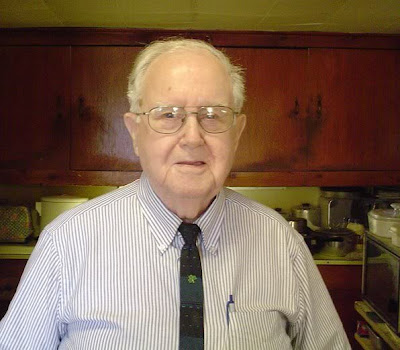
Yesterday our whole family piled into a tiny room at an eldercare facility and enjoyed an hour with our dear friend Dot. It truly was the smallest room I've ever seen in such a facility...and that's saying a lot, because I've visited far too many loved ones in long-term care facilities over the years. It required an instantaneous readjustment: from Dot who lives in the stately lifetime home with the grand piano, to Dot in an embryonic space with dozens of photos around her, three plants, four stuffed animals, and a TV. And the requisite hospital bed, which Dot is evidently confined to, now. I didn't have the heart to ask her, but she seems to be bed-and wheelchair-bound.
Case in point: two people I am proud to call my friends: Dorothy and Linwood. They have never met, but they have this in common: they are nonagenarians. Linwood's 92, and Dot is 95. They live in opposite corners of the same state.
Linwood is a retired station agent for the Bangor and Aroostook Railroad. Before he began his railroad career, he worked for the Civilian Conservation Corps (yes, the CCC!) during the Depression, and he also served in the U.S. Army during World War II. The words I would use to describe Linwood are humility, grace, vast practical knowledge, and deep kindness. He's my 2nd cousin once removed: his grandmother's brother was my great-grandfather. In my mind's eye, he's in his kitchen, which is really his mother's kitchen. Very little has changed in that house since his birth...just that it's a little disheveled now in a bachelor way. He welcomes you in, anyhow, and carefully shares stories of his life and his town. Never sappy or long-winded...just brings his community to life with simple descriptions. I do the genealogy, and he tells me of the personalities behind the names, the relationships, the houses they owned, the losses they experienced. He doesn't tire of company, and I've never been bored in his presence, either.
When I saw him last month, I said, "You should come visit us down on the Island, Linwood!" (This is where his CCC work was conducted, and I know he has vivid memories of those times.) "No," he said easily. "I don't leave here now. My traveling is done." The serenity in his voice when he said that to me was inspiring. And it made me hug him a little harder, when we said goodbye. I only wish I lived closer.
Dot lived next door to us before we moved onto the Island in 1996. She had been in her home since the 1950s, never had children, and her husband died many years ago. Much as with Linwood, Dot's home remained as it had been when two people lived there. Her living room was anchored by a sturdy grand piano that her husband had played in his lifetime. "Oh, he played beautifully," Dot would say, and you knew by the look on her face that she could hear it as she said it--and that she still admired Robert, her life-partner and friend. The piano was like having him in the room, sitting alongside us companionably.
Her living room had a well-worn teddy bear which was fair game for all young guests to hold and play with, and a dark-wood cabinet full of vintage, much-read children's books. We've spent many afternoons filling her downstairs, the six of us, and she's always welcomed our noisy presence. We could still have a deep conversation around the clamor of children, and she never flinches when they take a corner too fast and veer near some knickknacks. Plus, she always demonstrates her heirloom cuckoo clock, cast-iron piggy bank with the trick cannon, windup dancing Scotsman in a bottle...what kid isn't fascinated by those things?
I have talked to Dot about absolutely everything: my mom's illness, my children's issues at school, tough moments at my job, religious beliefs, happenings in our community, you name it. The insights she has provided me, the alternate outlooks, have been a blessing in hard times. And when things go right, when something's achieved...she magnifies that joy. Sometimes she tells about her girlhood in Pennsylvania, where she was one of many daughters and just one brother. Often we talk about the influence of parents on children...her own remembered example as vivid as the ones rambling around in her downstairs rooms.
Dot's descriptors: welcoming, wise, compassionate, spiritual. Well-read without being stuffy. Disdains medicines whenever she can, preferring to rely on her own five senses without blunting them, to know whether she's healthy or not. Dot has soft, silky white hair that she wears long, usually braided. Her face crinkles in a smile, more often than not. And knowing, kindly blue eyes. She shares that with Linwood, too.
Last Thursday night, I picked up our weekly local paper. I usually don't read it, but something made me dive in. I felt like I should catch up, maybe. And where I least expected it, I got news that made me utter, "Oh no, oh no...." That was in the real-estate section. New Listing: an address, a house photo, a description. God, I know that house. My heart knows it. Still, I checked the address to be sure. It's Dot's.
Tonight, at dusk, we were up in Dot's town...our former town. We drove down her street and pulled into her driveway. Noted the accursed For Sale sign on the lawn. I was nursing a hope that Dot had made this choice herself; that she was still residing there while potential buyers deliberated. Charming them in conversation, during the inevitable open house. That hope was dashed as I approached her back door. Through the kitchen window, I could see clear to the other side. Wan sunset light streamed into an empty kitchen. I could see the floor. Everything was gone.
I turned and faced her backyard, tears welling. There was her garden, Dot's pride and joy. She and a handyman maintained this paradise every year. Forget-me-nots, roses, asters, cosmos, and many other flowers whose names I could not recall, though Dot knew them all. My kids walked these little pathways many times. So have Dot and I. Sometimes she would take my arm lightly as we walked, and I was glad to protect her for just that little time. It was the least I could do in return for all the acceptance and love she had given me.
Dot has family elsewhere and she may well be with them...I don't know yet. But what I do know is that the garden was wearing autumn colors of brown and grey, and muted green. Plants were bent and shriveled, flowers spindly and seedy, trees nearly bare. A birdhouse sat forlornly in the middle...Dot loved her bird visitors. As I walked away, the garden felt as empty as the house. The spirit was gone from it.
I got back to the van, slid into my seat, shared the terrible news. Then Zoe exclaimed from the back seat, pointing at the windshield: "Look! One of her favorites--up there!"
On the slope of Dot's roof was perched a bluejay, almost a silhouette against the sky save for the white markings on its back. I held my breath while I looked at it, this astonishing sign. Before I was ready, it twitched its tail merrily, half-turned, and flew away.
UPDATE, October 10, 2006
Thank you so much to everyone who commented on last night's blog. I was comforted and heartened by your words.
In true smalltown style, I found out about Dot's situation this afternoon. You see, when we lived next door to Dot in the '90s, we were renting. Our landlord from those days is now my daughter's chemistry teacher at the high school. So today, Zoe asked him what happened. It's the best possible scenario: Dot's in an assisted living center, right here in our region. Evidently the family decided she was too unsteady on her feet to stay alone in her home anymore. While I'm sure this turn of events has made my friend sad, I am relieved that someone is helping her out and keeping her safe. And I hope to visit her soon and hear what she thinks about this new chapter in her life.
I thought I would share a few photos to accompany the blog, since you responded with such warmth and enthusiasm. Here is a photo of Dot and me from 2003. We're standing in her homey kitchen, and she's holding one of the many exquisite plants she nurtured there:

As Linwood is my cousin, I have gathered many wonderful images of him as part of my genealogy work. (Last summer I brought a scanner to his kitchen, balanced it on the old stove with my trusty iMac alongside, and we scanned our way through his life story!) Here is Linwood as a young boy in his hometown of Eagle Lake:

I so want to know him in his young-boy days! He looks by turns impish and unusually thoughtful.
This is Linwood during his tenure in the Civilian Conservation Corps, circa 1934:

A dashing serviceman during World War II:
A dashing serviceman during World War II:

And last year, when I did all the scanning, I also took this photo of him. (He built all of the cabinetry you see behind him, when he came home from the war.)

Interestingly, a good friend of mine just returned from a celebration in Massachusetts: her great-aunt Rose's 100th birthday party. I wish I could show you a picture of Rose, who looked beautiful, poised, and completely unsurprised to be 100 years old. There are so many fascinating stories out there waiting to be told by the elders we love....
UPDATE II, October 22, 2006: Our Visit with Dot
Yesterday our whole family piled into a tiny room at an eldercare facility and enjoyed an hour with our dear friend Dot. It truly was the smallest room I've ever seen in such a facility...and that's saying a lot, because I've visited far too many loved ones in long-term care facilities over the years. It required an instantaneous readjustment: from Dot who lives in the stately lifetime home with the grand piano, to Dot in an embryonic space with dozens of photos around her, three plants, four stuffed animals, and a TV. And the requisite hospital bed, which Dot is evidently confined to, now. I didn't have the heart to ask her, but she seems to be bed-and wheelchair-bound.
My next jolt was her hair, which has been shorn to a bob and has lost its characteristic white softness. Another fact which I filed away silently.
In no way did these conditions reflect on her sunny, welcoming face. It was as though the woes of her body were floating away from her sweet personality--disconnected. Three of us sat on her bed, three jammed into a side chair. The younger kids fooled around with her teddy bear and stuffed kitty, and the rest of us shared news of our worlds. Dot marveled that we have two high schoolers now, and that the kids have such diverse interests. Zoe brought out her ever-present sketchbook and showed recent work—emotionally immediate images of young people with big anime eyes. Dot loved it. We drew Dot's attention to some of her photos, and she told us stories of various relatives and friends. Meanwhile, Zoe feverishly began sketching the oldest photo in the room: Dot's two older sisters and her only brother as preschoolers, attired in turn-of-the-century white garments with dark stockings and laced-up ankle boots.
Dot was fully cognizant of everything except the passage of time--she is not at all certain of how long she has been at the facility, nor did she recollect our last visit to her home in July 2006. With her world limited to this space and a couple of common rooms, I imagine the pattern of day-to-night-to-day feels entirely optional. This does not seem to bother her, which increases my admiration for her even more. Really, she seems to feel safe and enveloped in this place...like the next stop on a journey, nothing more, nothing less. So many homes like this have crocheted afghans all around them...that would be the symbolic representation of how she's feeling: warmly protected.
At one point, Lydia's newfound interest in playing piano came up. "Lydie," I said, "do you remember the big piano Dot had in her living room?" I could have clapped my hand over my mouth as soon as I'd finished--what the hell did I say that for?!--but I stayed rigid, waiting.
"Oh," Dot said immediately, "I sold the grand piano, you know."
"...oh?" I answered in a stammer.
"Yes, it's west of the Mississippi now," she said airily, as if to say, imagine that!, and we all laughed.
Dignity without stuffiness. Belief without dogma. Femininity without a second's fuss. Graciousness personified. As we prepared to leave, she said, "You can come back as often as you'd like. Please do!"
And I need to correct my previous entry: this incredible, serene woman is nearly 98 years old.
01 January 1995
Everyone Called Her Nana: A Life
One of the first blog posts I ever put up on the Internet, via The Jackson Lab's old system of "personal" webpages.
__________________________________________________________
People know you in
This could be hard to take. My proprietary sense--heightened by the fact that I only had summers to spend with Nana, while my compatriots could see her year 'round--was challenged by the varied voices of those kids, peeking in the back door and asking Nana for a molasses cookie. Or just shouting "Hi, Nana!" as they rode by on a banana-seat bike, waving to her as she sat on the front porch. But I felt proud, too. I knew that their affection for her was only half of what I felt, and I was pleased that they knew as well as I did how special she was.
She was special from the start. Theresa Mary Pinette was born on September 28, 1896 in a farmhouse near
After the birth, there was reason to fear that my grandmother might not make it, either; she was premature, and that autumn was unusually harsh. The Pinettes kept the newborn next to the woodstove, warmly swaddled in a box. I always imagine the life of the farmhouse swirling around her in those early days; the busy activities of her older siblings--Eddie, Percy, Nellie, Essie, Bill, and Diddy (Elizabeth)--enhanced by her presence. Their games were a little easier now that a new baby was in the house again.
Tutta's nickname came from Diddy, three years older and obviously having trouble pronouncing names. She grew up as the imp of the family, occasionally exasperating them but always amusing them. Diddy would despair that her sister was just young enough to escape chores; Nellie, the oldest girl, would chide Diddy calmly and hand her a broom. All the Pinette children had to pitch in; their parents took in boarders, and that increased the workload. I'm not certain when the family made the exodus south to Millinocket, but it was the home Nana remembered most strongly, and the place she attended school.
Tut was not particularly fond of school, as a concept. She was impatient with the process of learning; she liked palling around with the boys better, although Diddy was by far the wilder tomboy. "In the winter," Nana used to regale me, "Diddy would climb up to the barn roof and jump right off it into a snowbank." (As I grew older, Nana maintained that Diddy's uterus had "tipped" as a result of her exploits, rendering her barren. The image has never left my mind.)

School continued to bore Nana (she admitted to me once that she had leveraged her friendships with boys into a cheating system for getting classwork done: "I just wasn't good at things like math," she smiled, and that seemed like an acceptable answer). In tenth grade, she announced that she was quitting. Rather than resign herself to a life of domestic drudgery, she decided to go to work. She was a clerk in a Millinocket store for awhile, but ultimately found the best career for her breezy personality when the local
She had already decided that she would be the child who would remain at home and care for her parents. (Her open good nature was always tempered with an overriding sense of responsibility, it seems.) The years passed easily; Nana loved her job and had a good circle of friends. She was the favorite Pinette aunt, because her single-and-working status allowed her to provide gifts and made her less careworn than her older siblings. Joseph and Elizabeth certainly benefitted from having their youngest around. She contributed to the finances of the house, and reassured them that they would not be alone as they grew older.


Their courtship was unusually long--four years. I've theorized that perhaps Nana was holding him at bay, feeling committed to her parents and the life she had made for herself. But Grampy ingratiated himself with the nieces and nephews (much as Nana had) and made it clear that he supported her intention to care for her parents. When they finally married in 1932, they set up house in the Pinettes' upstairs rooms.
Given Nana's age--36--they had only one child: a daughter, Maryann. They doted on her, and she did not disappoint. With her red hair and her amazing talent for playing piano, she was as recognizable as her mother was to the people of Millinocket.

As a grandmother, Nana was irrepressible and mothering at the same time. She made my childhood a joy, instructing patiently and always remaining optimistic. She taught me to knit, bake bread, make Saturday-night beans, sew on a treadle machine, bake molasses cookies, braid my hair, dress neatly, save money and shop enthusiastically, laugh uproariously, respect elders and love unabashedly. My mother shared many of these lessons with me, too, but Nana made companionship out of them. I spent every summer with my grandparents until I was 17 years old. Rarely was I bored, and always I felt safe. Having grown up in
Nana died on March 29, 1986. In her afterimage--memories, photos, even a precious recorded snippet of her voice--I still feel safe and hopeful, joyous and family-centered. Lessons you don't learn at school. I'm glad those who knew her in Millinocket sensed what she could teach. I'm glad she was mine to know.
 |
| Essie Pinette Gonya, me, and Theresa Pinette Arnold, 1974 |
Subscribe to:
Posts (Atom)