Showing posts with label grandmother. Show all posts

26 February 2011

After the hurricane


(Honestly, I'm not all grim all the time. Not even like 10% of the time. But sad things have happened, and I am driven to write about them...to gain understanding, mastery; to give shape.) So:

It's a famous case. There's a popular movie with an Oscar-winning actor, and a Bob Dylan song beloved and believed by people all over the world. I found out today there's a new autobiography by the man who claims he was falsely accused and framed. Nelson Mandela wrote the foreword.

 45 years later, and I still yearn for a woman I can't remember, my grandmother, whose life was tangled up in a dark, evil night, and there destroyed. The details of her wounding and death were horrific; given the subsequent literal hurricane of accusations, court papers, slippery evidence, conflicting testimonies, and raging controversy, Hazel's murder will never be solved. I accept that I will never know who did this to her, and I embrace the peace of that. But today, cnn.com commenters are debating all over again the innocence or guilt of the convicted man. And someone actually posted: "... after all this time, not sure it matters anymore."

What matters, then: Hazel was beautiful, truly. She had a lilting singing voice, coupled with a mischievous smile and a winning personality. She parented lovingly and fiercely, after a childhood of abandonment and poverty. She was mine, and I'll never have her. Needing my grandmother is one of the reasons I embarked on my genealogical journey in 2000. Piece by piece, and never with ease, I've reassembled and claimed her fragmented life story. Dates, names, places, from France to Québec, New England to New Jersey. Found the love, and the sadnesses too. Made my family whole.

 The poem I wrote about her a few years ago came out of me like water wrung from a cloth. It needed to happen, but it wrenched. I'm posting it now because this wound keeps getting seared open, and the poem is as close as I can come to wailing: STOP. Let her rest. Let her be Hazel. Give her back to us.

--------------------------------------------------------------

Grandmother, Lost

Fingering the corner of a faded photo,
I find myself in Hazel:
eyes that light and scrinch with grins,
appled cheeks, shy teeth,
chin, softly doubling,
dark wavy hair.

I've been told she feared aging
yet laughed uproariously and kidded often—
sardonic bend of her Jersey voice teasing,
sway of ample hips knowing as she walked away
carrying a loaded tray of food and drinks,
serving at a country club.

Dad kicked us out when I was four months old.
A family in shards, swept up,
discarded; then I was
shielded from everyone sharing my surname,
that lingering verb: Burns.

So Hazel dwelled in handlebars, silver as a mirror,
on the gleaming blue tricycle she'd given me
(only, living in the city, I maybe got to ride it once)—
cool sheen of the handlebars' curve
under my baby-plump palm, a tricycle
hopelessly parked indoors, new black tires
ready to move.

Today I move a smooth mouse, pointing
on the Internet, finding
an image when I search on her name:
the window of the Lafayette Bar and Grill, 1966,
"Rheingold" spelled in neon script
with a bullethole in the upper corner,
glass cracked like a twinkled star.

That's Hazel's bullet, one of five
that pierced her and left her for dead,
blasting from shotguns wielded by strangers.
And I am one of ten grandchildren:
a club that never met.

28 January 2009

Grand City

In my college days, when I wanted a dose of real life--separate from the enclosure of Bowdoin's quad and the sometimes stifling atmosphere therein--I headed downtown. I was an inveterate shopper anyway, having grown up in a Queens neighborhood that was hemmed in by shopping thoroughfares on all four sides. And in my grandparents' hometown of Millinocket, Maine, I loved nothing more than an idle stroll through the J.J. Newberry's on Penobscot Avenue, clutching my allowance and deliberating on that week's toy purchase.

Downtown Brunswick, in the 1980s, had two stores that were instantly familiar to me upon my freshman arrival: a J.J. Newberry's, and Grand City. Back then, Grand City was perched at the periphery of a Shop 'n Save parking lot. Years before, it had been a W.T. Grant's--and when that national chain went under, employees preserved the store and renamed it Grand City. I believe they selected this name because it allowed them to continue using the existing store signage--all they did was eliminate the "T'S" from GRANT'S, replacing it with a "D" and then a circle that held the word "City".

Grand City was close enough to my campus home that I could easily walk it, even on a dark subzero February evening. I made that trek innumerable times. Upon arrival, one's nose would be greeted with a smell that I cannot describe. Roasted nuts mingled with merchandise and candy? Hard to say. It was a smell that triggered instantaneous shopping behavior in me, I know that.

Everything I could possibly want was in that department store. A lamp, underwear, earrings, candy, jeans, bean-bag chairs, board games, picture frames, yarn and needles, silverware, stationery, shampoo, mittens. And socks. I love buying socks, and I'm fussy about them. In Maine's climate, you need warm socks, and Grand City never disappointed--they had some kind of arrangement with a factory which meant they had piles of seconds in lots of styles. So my college-student budget could buy socks and socks. Awaiting me at the registers were memeres....French-Canadian nanas. Back then, I had no idea a) how French I really am, and b) that I had numerous distant cousins in Brunswick. No matter--I always felt like I belonged among the ladies who worked the registers, and genealogy ultimately showed me why.

After I graduated from Bowdoin, Grand City remained a go-to for setting up my first apartment in Brunswick. Some years later, the J.J. Newberry's went under, and Grand City pounced on this opportunity to get a more intown slice of real estate. (Then the Shop 'n Save overspread their original footprint.) I'd left town by then, but I return to Brunswick often enough that I was relieved to know I could still rely on Grand City's presence...for, well, socks. And whatever other bargains I might come upon. So I've remained a patron. As did a lot of Brunswick residents, especially the retirees (can't speak for College students, because by the 1990s, Brunswick's ratio of big box stores had started to soar, and Bowdoin had greatly expanded its on-campus store as well).

You know where this is going, don't you? Grand City's lease came up for renewal last fall. The owner decided that between the economic forecast and his own sense of burnout, he would have to close. Thus, yet another store that triggers deep memories for me was fated to disappear. I lament the lack of photographic evidence of places I loved to shop (Freese's and Sears in Bangor, Newberry's in Millinocket and Ellsworth, among many.) So this time I was determined to capture Grand City before its demise.

During an October 2008 visit (Parents Weekend for my daughter, talk about rites of passage!), I ranged all over Grand City and took pictures without anyone even noticing. I wondered if maybe I was not the first. Whatever the case, the longer I snapped away, the more tearful I became. It's not the store, my friends. It's the ghostly presence of my mom and my nana and so many others of a generation that is sliding away. The objects they would be drawn to in a place like this...so many things. The community that existed because this mercantile is what it is.

The photos haunt me. They comfort me with what they captured, but they also sadden me. I won't caption them because geezum, I have blathered enough, and you can go ahead and get whatever you would like out of them. I already have.


As I stood here for the last picture I took, I could almost hear the word: Goodbye.


08 May 2007

The Diamond Anniversary

On May 8, 1932, a 35-year-old woman prepared for her wedding. A wedding she never expected to have, which resulted from a love story she never expected to be living. Her intended was 28 years old, a Canadian who had moved to her small Maine town eight years ago. You could say they were a study in contrasts: Fred was 5-foot-9, the very definition of strapping.

Whereas Theresa (always called Tut) was 5-foot-2 in her shoes. Even in her 30s, she was as adorable and diminutive as a doll.


Tut's temperament was doll-like, too…cheery, loving, and devoted. Fred--well, Fred was devoted to her, there was no question of that. But impatient! oh, never could anyone become exasperated like him. Not angry, not mean…just sputtery and annoyed. Tut smiled to herself whenever she thought of it. This man endeared himself to her with every fluster, every bluster. She calmed Fred, soothed him, and humored him. He had never smiled the way that she made him smile.

But married, she never expected. Fred started courting Tut when he was barely 21. How many times had she shaken her red-haired head and redirected him to a younger single woman in town? She thought Fred charming and insistent, but just a little misguided. Because Tut's devotion was to her parents. As their youngest, she had pledged that she would never leave home. Six siblings had left before her, married, and produced some two dozen children among them--all of whom cherished their Aunt Tutty for her uncomplicated generosity and young spirit. But really, Tut stayed behind for an unspoken reason that caused her pain, alarm, and concern in a mixed jumble: her parents' relationship was frayed, if not ruined completely.

Mama had always relied on her four daughters for house-tending and chores…even for cooking. With Mama now in her seventies, Tut was left to manage the household. What's worse, Mama held a seething grudge against her husband for the loss of their first home to foreclosure, two decades before. Tut adored her papa, who was temperamentally more like her than anyone else in the entire family. Papa was a peacemaker, an oasis of calm. Mama's fiery Irish ways may have drawn him irresistibly in their youth, but now she threatened to overwhelm him with spite. Tut served as their bridge, and for love of both of them, she would never leave.

Fred knew all of this. Years prior, he had heard it in conversation with Tut (as well as her friends, who privately mourned the spinster path she was on). Then, Fred gradually got to know her family. He saw the jagged dynamics in person. And he made a simple statement to the beautiful woman he wanted to marry: "I will never take you away. If you want to live with your parents, I'll do that."

Tut let herself fall in love with him at that moment. But she didn't let on, right away. Fred's desire, his adoration was almost too much for her to bear. Whenever she looked in the mirror, she saw a woman eight years his senior. What kind of existence would this be for a young man in his twenties, the prime of his life? Why, at her age, she probably wouldn't even be able to bear him one child, let alone the many that her sisters had borne.

On May 8, 1932, Theresa adjusted her hair nervously in that same mirror. She wore a modest dress, not fancy wedding attire. Fred was a Methodist, and Tut was devoutly Catholic. For this reason, the wedding was to be held in the rectory of the church: a non-event, meant to deflect attention. Her sister and brother-in-law would serve as witnesses. No guests, no rice, no toasts, no extravagance. Just two people--opposites, attracted--in a small town.

Make that three people. Inside her that day, Tut nurtured a new life--the hidden fact of a pregnancy. Her lifelong modesty makes it impossible to imagine the moment that she gave in to Fred's advances. In a boxy old car? Unthinkable. In her parents' house? Never. In the rooming house where Fred lived sparsely? Doubtful. The place is not important, anyway. Somehow, in the winter of 1932, Fred had convinced Tut. And at the age of 35, she must have asked herself, what was there to lose, really?

No one in Millinocket, Maine, would have been surprised at the subsequent wedding of Fred and Tut. There was nothing abrupt about it; they had been dating for four years solid. Surely their acquaintances rejoiced, having known for years what a perfect couple they made. And her nieces and nephews clung to Fred's lanky frame as though he were already their uncle. Therefore, the baby that Tut carried on May 8 remained a closely held secret. Instead, a few weeks after the priest pronounced them man and wife, Tut and Fred shared joyful news with family and friends that made sense in the timeline: now, they were expecting.

Tut's parents allotted the newlyweds the upstairs of their old, austere house. Tut, who had worked all of her adult life as a gregarious telephone operator, gave up her job and took an even more active role in her parents' daily lives. Fred worked long hours as a railroad telegrapher to support them.

Some months later, the trees were bare, the winds grew cold, and the birth of their baby was nearing--substantially sooner than anyone would have thought. In a masterstroke of plotting, Tut was sent south on the Bangor and Aroostook Railroad to visit her sister Nellie in Augusta. There, Tut awaited her confinement, which came "prematurely" (Fred told the folks back home). Her sister was undoubtedly in on the ruse. In Augusta, on November 27, 1932, Tut delivered a full-term baby girl.

Perhaps Tut would have been better off delivering a preemie. Her tiny pelvis struggled with the birthing, and in the days afterwards, she experienced intestinal difficulties that threatened her life. At one point, the doctor admonished Fred: "Don't ever get her pregnant again." He visibly blanched, nodding his assent.

These events of 75 years ago are part of my DNA. The baby girl was my mother, Maryann. Tut and Fred were my beloved grandparents, from whom I learned about marital love, attraction, respect, and cooperation. It is nearly impossible to explain how safe and cherished I felt in their company--it was beyond a parenting relationship, into something spiritual, a glow that suffused me.

It wasn't until my young adulthood that I learned the full story surrounding this wedding day, and the secret they harbored throughout the years. As the puzzle pieces fell into place, I understood why they never, ever celebrated their anniversary, why they had no wedding pictures, no wedding memories. And as I contemplated all of these events on this year's anniversary--which I choose to commemorate, despite the fact that both Fred and Tut are both deceased--I couldn't help but wonder at the contrast between their surreptitious wedding day, and their lifelong, deep-rooted, inspiring love for each other. In my life, I've met maybe a dozen married couples whose bond and friendship is immediately, tangibly obvious. I compare all of them to my grandparents, who showed me that first.


How sad that the day these loving people were married brought them guilt and shame. How triumphant that they stayed together for life, and never let that submerged secret spoil what they had. My mother's birth, after the complications were cleared, fulfilled both of them in a way I don't think they had anticipated. And while I know they ached for more children, Fred would never have risked losing his sweet wife. Instead, when their two grandchildren arrived, they shared all of that long-held parenting energy with my brother and me. For that, I owe them everything.

Through all of the tumult and nerves, 75 years ago, I can see a moment in the rectory--maybe when the priest was droning from a text in front of him, maybe when the plain gold bands were exchanged--when Fred looked at Tut, caught her eye, and smiled that mischievous and satisfied smile that only she could elicit. And at that moment, I know she smiled right back. Her misgivings had been foolish. He was the one.

An important footnote to this story: up until tonight, I had never seen a photograph of my grandparents' wedding day. I decided to flip through my digital archives to illustrate this story--I have many images of them, just not of their wedding.

Two years ago, my cousin Earle e-mailed me some images, and those were among the files I looked at tonight. I'm very fond of one of them, which appears below. Ever since Earle sent it, I've puzzled over it: why are Nana and Grampy standing there so awkwardly, on the right? Who are the two people with them? Where are they, anyway?


In a bolt of clarity that any genealogist will understand, I suddenly realized tonight that this is the only surviving wedding picture. They are standing on a hillside: that's right across the street from Millinocket's Catholic church. I know that hill like the back of my hand. The two people on the left? That's the witnesses, Eugene and Essie.

First I felt driven to write about their wedding day, and then, I saw it. The ancestors speak to us, that's all I can tell you. And tonight, their diamond anniversary, they led me to this.

20 October 2006

Meeting Ellen

There's a lot of paternalism about genealogy. The surnames that motivate most family historians are paternal--understandably so, since those names stay the same (well, nearly, given the vicissitudes of spelling and immigration). Male decisions seem to have motivated most of the migratory shifts that make my genealogy what it is-the choices that brought French, Irish, German, English, Welsh, etc. etc. all together to ultimately produce me and Peter. When you input "occupation" for an ancestor, you're adding in an array of arcane pursuits: carpenter, farmer, miner, cigar roller, paper maker, railroad station agent--but usually the women's are pretty basic: "keeping house" was the nineteenth-century census shorthand for being a mother and a wife. I always picture those beleaguered 1800s women clutching a broom as the census taker enters the house. Yup, there she is, keeping house...just like all the other women on this block. Then the census taker scribbles it in the occupation box with a knowing sigh. I then force myself to comprehend what those women's occupations meant: tending home and hearth for a dozen or more children, preparing meals over an actual fire, sewing clothing, darning, washing everything in sight, tending to injuries, worrying, probably pregnant again, dispensing love in a harsh world.

If you've read this blog for awhile, you already know that I'm a major grandmother fan. So when I started out mining data for family history purposes, my motivation was actually much more maternal than it was paternal. Both my grampy and my dad had lost their mothers suddenly and tragically, and they talked about them in vivid ways. Who were these women? Where did they come from?

It's been six years now since I set my mind, my heart, and my computer to the task of gathering my family--and Pete's--into a full-blown databased entity. Six years of meet-ups with excited cousins...weepy moments in musty record rooms when the piece of data confirms a family legend...long, lonely nights of data entry, the sounds of my household swirling behind me as I type and type and type...triumphant print-outs that show my progress.

And last night, I met my mother's mother's mother's mother. Ellen Finn, of County Cork, Ireland.

Well, I knew about her before. But a key piece of photographic evidence seems to indicate that now, I have seen her at three stages of her life:

The image on the right was just given to me by an elder cousin who stated that this was his grandmother, Ellen Finn. And the other two images had previously been given to me by cousins who shrugged and said, "I don't know who this is. Maybe you can figure it out."

Before I met Ellen photographically, I had assembled her life story from family lore and stark data. She was one of three (if not four) siblings in her family to emigrate from a famine-stricken location to, of all places, northern Maine. She made this journey by way of the Baie des Chaleurs, which curves around the northern portion of New Brunswick, Canada. Ellen arrived in Maine circa 1851, around age 17. Within the year she had married my great-great-grandfather, William Emmett Brown, also a recent Irish immigrant. They established a household that overlooked a shimmering lake encircled by pines and birches and maples...not a Vacationland lake, mind you, but a lake teeming with fish to feed a family. Then, Ellen's husband set about defining the town government structure of what became Eagle Lake, Maine. He was also a healer (both faith- and medicine-based), and took frequent journeys with a horse and a buggy full of remedies to southern Maine and Massachusetts, where presumably people paid him to feel better from rheumatism, pleurisy, dropsy, hysteria, and other ailments of the era.

Ellen, true to census form, kept house while William roamed. She bore him at least 10 children. I believe that she wielded a broom fiercely, and probably took a few swipes at that dreamer husband of hers when he got a wild idea about traveling south again. 

Eventually, William opened Eagle Lake's first pharmacy, which apparently brought some level of prosperity because Ellen got a servant. In fact, some of my living cousins are the children of the young maid named Delia who took care of the Brown household. Delia was about 14 when she started that job; she was 15 when one of Ellen and William's sons took her for his bride. (For a glimpse of turn-of-the-century mores, please note that he was 25. And that in their wedding picture, he looks dashing and daring, and she looks blue-eyed-pretty and a little stunned.) 

Delia always told her children that Ellen was fiery. That she had a thick Irish brogue, which even applied to French phrases like Baie des Chaleurs (which Ellen referred to as theBay dee Chaloor.) Probably Ellen's stiff demeanor came from a lifetime of sacrifices. She left County Cork and never saw her parents or her homeland again. She adapted to a place that was freezing cold for much of the year, where 98% of the people were native French speakers, and where her husband was out-and-about in pursuit of business, politics, and, bizarrely, the instinct to heal. She lost a number of children in her lifetime, including her youngest son, who was forced to flee west when a local girl accused him of getting her pregnant. The son, Edmund, swore it was not his child. Ellen and her children rallied behind him and shipped him off to Minnesota, where Ellen's brother Thomas resided. Ellen must have lamented his departure terribly...for just one year prior, her husband had died.
Here's something else I have learned about Ellen: she had a soft side. Maybe she didn't want us to know that--I mean, look at the way she glares out of those photos that bring her to us. But what betrayed her was her beautiful singing voice. Numerous grandchildren remembered being held in Ellen's arms in a rocking chair, while she sang to them in Gaelic. Some reported that Ellen had aspired to be a professional singer, before the boat came and hauled her away to northern Maine for the rest of her days. I feel certain that her lilting voice is what endeared her to William Emmett Brown, the dreamer who needed a practical partner.

Perhaps the baby in her arms, above, was one of the grandchildren whose night fears she soothed with a clear and lovely voice. Keeping house, indeed, for all of us who descend from her.

03 January 2006

Grandmother worship

You know, it could take me decades to figure out my relationship with my mom, God rest her soul—and I think I will probably opt not to figure it out, ultimately. I'm cool with that balance of good and not-good...it defined us.

But today I realized that my grandmothers are a completely different story. I openly adore them. In fact, I emulate them. This will be a story with pictures, because part of what I love so much is their demeanor as young women.

Herewith, my nanas:

Theresa, who went by the nicknames "Tut" and "Tutta" all her life:


and Hazel:


These serene-looking young women were both of French Quebecois families, although their lives could not have been more different. Tutta was the "spoiled," cherished youngest of seven children in a small Maine town. Hazel was the eldest of a broken family in Lowell, MA. She and her 4 sibs were frequently shunted to orphanages, despite the fact that both parents were living...they just perenially ran out of money or, I have been told, just decided they were tired of dealing with their kids. Those orphanages were even worse than you think they were.

And yet...and yet, Hazel was a young woman of surpassing optimism, supreme flirtatiousness, and high spirits. Just like her counterpart, Tutta. You could not call either woman complicated. The love they radiated to their families was all-encompassing, and both of them worked diligently without complaint (despite the myth that American mothers never worked until the 1970s. Puh-leeze.)

Tut was a telephone operator. As such, she had her finger (or, in this case, her ear) on the pulse of her small hometown. Knew who was calling whom, and sometimes knew what was said. She was mischievous about this info, but never malicious. And my grampy fell in love with her because every time he tried to place a call through the sweet-voiced operator in his newly adopted town, she sent him astray. He'd call and say, "Connect me to the railroad station," and she'd hook him up with the fire department. Or he'd ask for the grocery store and get a priest. He acted all put out, but inside, he was impressed as hell with her gutsy humor.

When they met, my grampy Fred just melted. She was red-headed and fearless. Eight years older than he, she was also a full foot shorter, and acted younger than he did. And she had long since decided she would never marry. He took four years to persuade her.

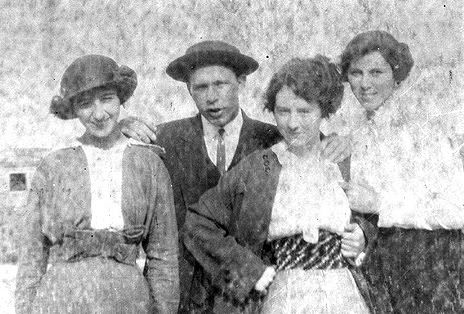
This image demonstrates what a spitfire she was. Tut's third from the left, the spunky one. The others in the pic are childhood friends:


Fred and Tut stayed married until her death in 1986. I took this picture of them, and it says it all—the respect, the connection, the fun they shared:


Hazel, meanwhile, toiled at various difficult jobs—nursemaid, textile factory worker, waitress. The man she married was considerably less respectful than Fred, unfortunately, and he drank too much. There was never enough money, there were fights and separations and reunions. When they finally split for good, it was in name only—their hearts stayed intertwined, I'm told. This is the beautiful girl my grandfather Frank met and fell for:


What sass! What shape! I completely admire Hazel when I see this photo.

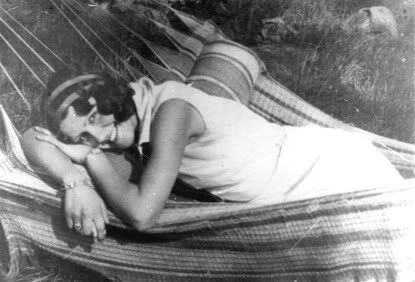
As she reached midlife, I'm told that Hazel dreaded aging. But she kept her optimism—one friend of hers told me that she was "full of hell," all twinkling eyes and hip-shimmy. And like Tutta, all of Hazel's paramours were younger than she. I recently found this photo of Hazel from the 1960s:


Hazel held me as an infant, and she gave me beloved presents as a toddler. But I cannot remember her. She was killed in a New Jersey bar one night, on her way home from a late shift waitressing at the country club. It was a very famous crime, but I'm not interested in rehashing the gruesome, disputed details. Instead, I concentrate on her spirit: the belief in herself that brought her out of orphanages and sadness, and into determination and fierce love of family.

God blessed me with Tutta throughout my young life. She died when I was 22, and I'll never get over her absence. She was my guiding, calming influence, the teacher who never lectured.


I didn't know anything substantive about Hazel, ironically, until right after Nana died. That's when my father and I spoke for the first time ever in my life, and started exchanging letters. Soon after, his brother Larry gave me the treasured young pictures of her, above. Larry and Dad have both passed away, but I immersed myself in knowing them while I could. Becoming one of them, after years of not knowing that side of myself. Moreover, I now knew whom I most closely resembled.

I guess my grandmother worship comes down to this: I should be so lucky as to have half the integrity of these remarkable women. And how impressive is it that just the sight of them, in photos, suffuses me with love for them all over again?

01 January 1995

Everyone Called Her Nana: A Life


One of the first blog posts I ever put up on the Internet, via The Jackson Lab's old system of "personal" webpages.
__________________________________________________________

People know you in Millinocket, Maine by your family name. "Isn't she a Hathaway?" "He's one of them _____________s" (fill in the blank; I'm no fool.) In this vein, I'm one of the Pinette girls, only two generations removed. My grandmother, affectionately called "Tut" or "Tutta" by nearly all the adults in her acquaintance, was one of the original Pinette girls of Millinocket. To the children on and around Penobscot Avenue in the 1970s, she was Nana.

This could be hard to take. My proprietary sense--heightened by the fact that I only had summers to spend with Nana, while my compatriots could see her year 'round--was challenged by the varied voices of those kids, peeking in the back door and asking Nana for a molasses cookie. Or just shouting "Hi, Nana!" as they rode by on a banana-seat bike, waving to her as she sat on the front porch. But I felt proud, too. I knew that their affection for her was only half of what I felt, and I was pleased that they knew as well as I did how special she was.

She was special from the start. Theresa Mary Pinette was born on September 28, 1896 in a farmhouse near Eagle Lake, Maine. Her hair was flaming red even at birth, family legend has it. More importantly, she was a precious, exact-lookalike replacement for the infant girl who had died the year before. Her parents, Elizabeth and Joseph Pinette, named her Theresa after this lost sister. Nana always reported this fact with gentle pride, conveying a sense of responsibility for the near-twin who'd preceded her.

After the birth, there was reason to fear that my grandmother might not make it, either; she was premature, and that autumn was unusually harsh. The Pinettes kept the newborn next to the woodstove, warmly swaddled in a box. I always imagine the life of the farmhouse swirling around her in those early days; the busy activities of her older siblings--Eddie, Percy, Nellie, Essie, Bill, and Diddy (Elizabeth)--enhanced by her presence. Their games were a little easier now that a new baby was in the house again.

Tutta's nickname came from Diddy, three years older and obviously having trouble pronouncing names. She grew up as the imp of the family, occasionally exasperating them but always amusing them. Diddy would despair that her sister was just young enough to escape chores; Nellie, the oldest girl, would chide Diddy calmly and hand her a broom. All the Pinette children had to pitch in; their parents took in boarders, and that increased the workload. I'm not certain when the family made the exodus south to Millinocket, but it was the home Nana remembered most strongly, and the place she attended school.

Tut was not particularly fond of school, as a concept. She was impatient with the process of learning; she liked palling around with the boys better, although Diddy was by far the wilder tomboy. "In the winter," Nana used to regale me, "Diddy would climb up to the barn roof and jump right off it into a snowbank." (As I grew older, Nana maintained that Diddy's uterus had "tipped" as a result of her exploits, rendering her barren. The image has never left my mind.)

Meanwhile, the older Pinette girls had discovered men. Nellie was plainer than Essie, but her smile was friendly and welcoming. Essie took pride in her beauty, and her creamy complexion is evident even in sepia-toned photographs. The above photo eloquently depicts the Pinette girls' dilemma: Essie (left) and Nellie are seated on a beautiful grassy knoll with their unidentified dates. All are dressed in their finest summer attire. Lush leaves shade the background. In the exact center of the photo, an arm slung around each sister's shoulder, is Tut Pinette. She looks about twelve. Her sisters' hair is contained in demure buns; Tut's obviously red locks are flying free from the effort to contain them. In contrast to the dress-up outfits that surround her, my grandmother is wearing what looks like a nightie, some brief white cotton playdress that allows her to climb a tree if she so desires. The gentlemen smile gamely, the sisters can't help but smile wider, and Tut's giving a hearty laugh.

School continued to bore Nana (she admitted to me once that she had leveraged her friendships with boys into a cheating system for getting classwork done: "I just wasn't good at things like math," she smiled, and that seemed like an acceptable answer). In tenth grade, she announced that she was quitting. Rather than resign herself to a life of domestic drudgery, she decided to go to work. She was a clerk in a Millinocket store for awhile, but ultimately found the best career for her breezy personality when the local Bell telephone office hired her as an operator.

She had already decided that she would be the child who would remain at home and care for her parents. (Her open good nature was always tempered with an overriding sense of responsibility, it seems.) The years passed easily; Nana loved her job and had a good circle of friends. She was the favorite Pinette aunt, because her single-and-working status allowed her to provide gifts and made her less careworn than her older siblings. Joseph and Elizabeth certainly benefitted from having their youngest around. She contributed to the finances of the house, and reassured them that they would not be alone as they grew older.

In 1928, while she worked the switchboard, a call came in that changed her life. In Millinocket as in any small American town of the day, switchboard operators had their fingers on the pulse. If someone new arrived, they'd be the first to hear the voice and spread the word. Nana heard a new male voice, and liked the sound of it very much. Knowing my grampy, he must have sounded by turns manly and impatient. And some tone in that voice must have suggested that good humor lurked within. Nana began a campaign of practical jokes, operator-style. Whenever Fred Arnold's voice came across her headset, she connected him to the wrong number. Poor Grampy encountered the parish priest, the undertaker, the fire department...anyone but the party he'd requested.

Nana's foolery attracted the Canadian emigrant's attention. (He'd come to Millinocket to work at the B & A Railroad station as a telegrapher.) When Fred and Tut finally met, they realized that she was eight years older than he. Tutta, ever the spark-plug, started fixing him up with the younger girls in her acquaintance. Fred returned from each date feeling impatient ("It's you I want to be with, Tut!"). After awhile, she got the message.

Their courtship was unusually long--four years. I've theorized that perhaps Nana was holding him at bay, feeling committed to her parents and the life she had made for herself. But Grampy ingratiated himself with the nieces and nephews (much as Nana had) and made it clear that he supported her intention to care for her parents. When they finally married in 1932, they set up house in the Pinettes' upstairs rooms.

Given Nana's age--36--they had only one child: a daughter, Maryann. They doted on her, and she did not disappoint. With her red hair and her amazing talent for playing piano, she was as recognizable as her mother was to the people of Millinocket.

Nana's life settled down with marriage and parenthood to consider. As my mother tells it, Nana was somewhat of an anxious parent, perhaps even more so after she left her parents' home and set up her own with Grampy. The older-parent, only-child situation played out much as it always does; my mother ultimately felt stifled in her small-town home, and left Millinocket as soon as she graduated high school. Maryann was gifted with her mother's youthful sense of adventure: she became a jazz musician in New York City. Nine years later, she started her own family: her son Sean was born in 1959, and I was born four years later.

As a grandmother, Nana was irrepressible and mothering at the same time. She made my childhood a joy, instructing patiently and always remaining optimistic. She taught me to knit, bake bread, make Saturday-night beans, sew on a treadle machine, bake molasses cookies, braid my hair, dress neatly, save money and shop enthusiastically, laugh uproariously, respect elders and love unabashedly. My mother shared many of these lessons with me, too, but Nana made companionship out of them. I spent every summer with my grandparents until I was 17 years old. Rarely was I bored, and always I felt safe. Having grown up in New York City, this latter was a wonderful gift to me.

Nana died on March 29, 1986. In her afterimage--memories, photos, even a precious recorded snippet of her voice--I still feel safe and hopeful, joyous and family-centered. Lessons you don't learn at school. I'm glad those who knew her in Millinocket sensed what she could teach. I'm glad she was mine to know.
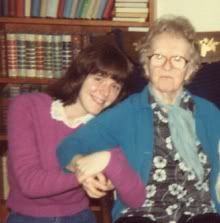
Essie Pinette Gonya, me, and Theresa Pinette Arnold, 1974